ARG70817
Human ApoJ / Clusterin recombinant protein (His-tagged, C-ter)
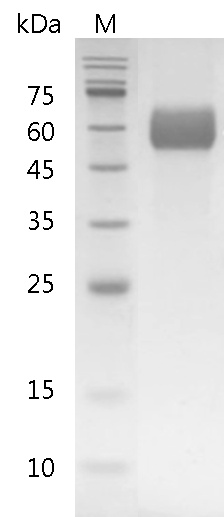
Human ApoJ / Clusterin recombinant protein (His-tagged, C-ter) for SDS-PAGE
Overview
| Product Description | HEK293 expressed, His-tagged (C-ter) ApoJ / Clusterin recombinant protein |
|---|---|
| Tested Application | SDS-PAGE |
| Target Name | ApoJ / Clusterin |
| Species | Human |
| A.A. Sequence | Asp23 - Glu449, with a deletion of Arg214 - Leu238. |
| Expression System | HEK293 |
| Alternate Names | Clusterin; Apolipoprotein J; SGP-2; SP-40; APOJ; ApoJbeta; CLU2; CLU1; NA1/NA2; TRPM2; CLI; SGP2; Apo-J; TRPM-2; ApoJalpha; Aging-associated gene 4 protein; APO-J; Complement cytolysis inhibitor a chain; Ku70-binding protein 1; Complement cytolysis inhibitor b chain; Testosterone-repressed prostate message 2; Complement-associated protein SP-40,40; KUB1; AAG4; Complement cytolysis inhibitor |
Properties
| Form | Powder |
|---|---|
| Purification Note | Endotoxin level is less than 1 EU/µg of the protein, as determined by the LAL test. |
| Purity | > 95% (by SDS-PAGE) |
| Buffer | PBS (pH 7.4) |
| Reconstitution | It is recommended to reconstitute the lyophilized protein in sterile water to a concentration not less than 200 μg/mL and incubate the stock solution for at least 20 min at room temperature to make sure the protein is dissolved completely. |
| Storage Instruction | For long term, lyophilized protein should be stored at -20°C or -80°C. After reconstitution, aliquot and store at -20°C or -80°C for up to one month. Storage in frost free freezers is not recommended. Avoid repeated freeze/thaw cycles. Suggest spin the vial prior to opening. |
| Note | For laboratory research only, not for drug, diagnostic or other use. |
Bioinformation
| Gene Symbol | CLU |
|---|---|
| Gene Full Name | clusterin |
| Background | The protein encoded by this gene is a secreted chaperone that can under some stress conditions also be found in the cell cytosol. It has been suggested to be involved in several basic biological events such as cell death, tumor progression, and neurodegenerative disorders. Alternate splicing results in both coding and non-coding variants.[provided by RefSeq, May 2011] |
| Function | Isoform 1 functions as extracellular chaperone that prevents aggregation of nonnative proteins. Prevents stress-induced aggregation of blood plasma proteins. Inhibits formation of amyloid fibrils by APP, APOC2, B2M, CALCA, CSN3, SNCA and aggregation-prone LYZ variants (in vitro). Does not require ATP. Maintains partially unfolded proteins in a state appropriate for subsequent refolding by other chaperones, such as HSPA8/HSC70. Does not refold proteins by itself. Binding to cell surface receptors triggers internalization of the chaperone-client complex and subsequent lysosomal or proteasomal degradation. Secreted isoform 1 protects cells against apoptosis and against cytolysis by complement. Intracellular isoforms interact with ubiquitin and SCF (SKP1-CUL1-F-box protein) E3 ubiquitin-protein ligase complexes and promote the ubiquitination and subsequent proteasomal degradation of target proteins. Promotes proteasomal degradation of COMMD1 and IKBKB. Modulates NF-kappa-B transcriptional activity. Nuclear isoforms promote apoptosis. Mitochondrial isoforms suppress BAX-dependent release of cytochrome c into the cytoplasm and inhibit apoptosis. Plays a role in the regulation of cell proliferation. [UniProt] |
| Cellular Localization | Isoform 1: Secreted. Note=Can retrotranslocate from the secretory compartments to the cytosol upon cellular stress. Nucleus. Cytoplasm. Mitochondrion membrane; Peripheral membrane protein; Cytoplasmic side. Cytoplasm, cytosol. Microsome. Endoplasmic reticulum. Cytoplasmic vesicle, secretory vesicle, chromaffin granule. [UniProt] |
| PTM | Isoform 1 is proteolytically cleaved on its way through the secretory system, probably within the Golgi lumen. Polyubiquitinated, leading to proteasomal degradation. Heavily N-glycosylated. About 30% of the protein mass is comprised of complex N-linked carbohydrate. [UniProt] |
Images (1) Click the Picture to Zoom In
-

ARG70817 Human ApoJ / Clusterin recombinant protein (His-tagged, C-ter) SDS-PAGE image
SDS-PAGE analysis of ARG70817 Human ApoJ / Clusterin recombinant protein (His-tagged, C-ter).