ARG70716
Human BACE1 recombinant protein (His-tagged, C-ter)
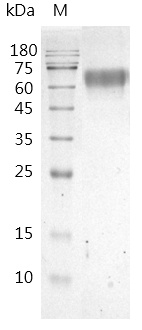
Human BACE1 recombinant protein (His-tagged, C-ter) for SDS-PAGE
Overview
| Product Description | CHO expressed, His-tagged (C-ter) BACE1 recombinant protein |
|---|---|
| Tested Application | SDS-PAGE |
| Target Name | BACE1 |
| Species | Human |
| A.A. Sequence | Thr 22 - Thr 457 |
| Expression System | CHO |
| Alternate Names | Beta-site APP cleaving enzyme 1; BACE; Beta-secretase 1; Membrane-associated aspartic protease 2; HSPC104; Memapsin-2; ASP2; Asp 2; EC 3.4.23.46; Aspartyl protease 2; Beta-site amyloid precursor protein cleaving enzyme 1 |
Properties
| Form | Powder |
|---|---|
| Purification Note | Endotoxin level is less than 0.1 EU/µg of the protein, as determined by the LAL test. |
| Purity | > 95% by SDS-PAGE gel and HPLC analyses. |
| Buffer | PBS (pH 7.4) |
| Reconstitution | It is recommended to reconstitute the lyophilized protein in sterile water to a concentration not less than 200 μg/mL and incubate the stock solution for at least 20 min at room temperature to make sure the protein is dissolved completely. |
| Storage Instruction | For long term, lyophilized protein should be stored at -20°C or -80°C. After reconstitution, aliquot and store at -20°C or -80°C for up to one month. Storage in frost free freezers is not recommended. Avoid repeated freeze/thaw cycles. Suggest spin the vial prior to opening. |
| Note | For laboratory research only, not for drug, diagnostic or other use. |
Bioinformation
| Gene Symbol | BACE1 |
|---|---|
| Gene Full Name | beta-site APP-cleaving enzyme 1 |
| Background | Cerebral deposition of amyloid beta peptide is an early and critical feature of Alzheimer's disease. Amyloid beta peptide is generated by proteolytic cleavage of amyloid precursor protein (APP) by two proteases, one of which is the protein encoded by this gene. The encoded protein, a member of the peptidase A1 protein family, is a type I integral membrane glycoprotein and aspartic protease that is found mainly in the Golgi. Multiple transcript variants encoding different isoforms have been described for this gene. [provided by RefSeq, May 2011] |
| Function | Responsible for the proteolytic processing of the amyloid precursor protein (APP). Cleaves at the N-terminus of the A-beta peptide sequence, between residues 671 and 672 of APP, leads to the generation and extracellular release of beta-cleaved soluble APP, and a corresponding cell-associated C-terminal fragment which is later released by gamma-secretase. [UniProt] |
| Cellular Localization | Membrane; Single-pass type I membrane protein. Golgi apparatus, trans-Golgi network. Endoplasmic reticulum. Endosome. Cell surface. Cytoplasmic vesicle membrane. Membrane raft. Note=Predominantly localized to the later Golgi/trans-Golgi network (TGN) and minimally detectable in the early Golgi compartments. A small portion is also found in the endoplasmic reticulum, endosomes and on the cell surface. [UniProt] |
| PTM | N-Glycosylated. Acetylated in the endoplasmic reticulum at Lys-126, Lys-275, Lys-279, Lys-285, Lys-299, Lys-300 and Lys-307. Acetylation by NAT8 and NAT8B is transient and deacetylation probably occurs in the Golgi. Acetylation regulates the maturation, the transport to the plasma membrane, the stability and the expression of the protein. Palmitoylation mediates lipid raft localization. [UniProt] |
Images (1) Click the Picture to Zoom In
-
ARG70716 Human BACE1 recombinant protein (His-tagged, C-ter) SDS-PAGE image
SDS-PAGE analysis of ARG70716 Human BACE1 recombinant protein (His-tagged, C-ter).