ARG70771
Human C Reactive Protein recombinant protein (His-tagged, C-ter)
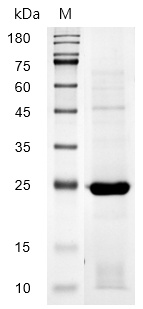
Human C Reactive Protein recombinant protein (His-tagged, C-ter) for SDS-PAGE
Overview
| Product Description | CHO expressed, His-tagged (C-ter) C Reactive Protein recombinant protein |
|---|---|
| Tested Application | SDS-PAGE |
| Target Name | C Reactive Protein |
| Species | Human |
| Expression System | CHO |
| Alternate Names | 1-205; PTX1; C-reactive protein |
Properties
| Form | Powder |
|---|---|
| Purification Note | Endotoxin level is less than 0.1 EU/µg of the protein, as determined by the LAL test. |
| Purity | > 90% (by SDS-PAGE) |
| Buffer | PBS (pH 7.4) |
| Reconstitution | It is recommended to reconstitute the lyophilized protein in sterile water to a concentration not less than 200 μg/mL and incubate the stock solution for at least 20 min at room temperature to make sure the protein is dissolved completely. |
| Storage Instruction | For long term, lyophilized protein should be stored at -20°C or -80°C. After reconstitution, aliquot and store at -20°C or -80°C for up to one month. Storage in frost free freezers is not recommended. Avoid repeated freeze/thaw cycles. Suggest spin the vial prior to opening. |
| Note | For laboratory research only, not for drug, diagnostic or other use. |
Bioinformation
| Gene Symbol | CRP |
|---|---|
| Gene Full Name | C-reactive protein, pentraxin-related |
| Background | The protein encoded by this gene belongs to the pentaxin family. It is involved in several host defense related functions based on its ability to recognize foreign pathogens and damaged cells of the host and to initiate their elimination by interacting with humoral and cellular effector systems in the blood. Consequently, the level of this protein in plasma increases greatly during acute phase response to tissue injury, infection, or other inflammatory stimuli. [provided by RefSeq, Sep 2009] |
| Function | Displays several functions associated with host defense: it promotes agglutination, bacterial capsular swelling, phagocytosis and complement fixation through its calcium-dependent binding to phosphorylcholine. Can interact with DNA and histones and may scavenge nuclear material released from damaged circulating cells. [UniProt] |
Images (1) Click the Picture to Zoom In
-
ARG70771 Human C Reactive Protein recombinant protein (His-tagged, C-ter) SDS-PAGE image
SDS-PAGE analysis of ARG70771 Human C Reactive Protein recombinant protein (His-tagged, C-ter).