ARG70819
Human CA9 / Carbonic Anhydrase 9 recombinant protein (His-tagged, C-ter)
Human CA9 / Carbonic Anhydrase 9 recombinant protein (His-tagged, C-ter) for SDS-PAGE
Overview
| Product Description | CHO expressed, His-tagged (C-ter) CA9 / Carbonic Anhydrase 9 recombinant protein |
|---|---|
| Tested Application | SDS-PAGE |
| Target Name | CA9 / Carbonic Anhydrase 9 |
| Species | Human |
| A.A. Sequence | Met1 - Asp414 |
| Expression System | CHO |
| Alternate Names | CA9; Carbonic Anhydrase 9; CAIX; MN; Carbonic Anhydrase IX; Renal Cell Carcinoma-Associated Antigen G250; RCC-Associated Protein G250; RCC-Associated Antigen G250; Carbonate Dehydratase IX; Carbonic Dehydratase; Membrane Antigen MN; P54/58N; CA-IX; PMW1; EC 4.2.1.1; G250 |
Properties
| Form | Powder |
|---|---|
| Purification Note | Endotoxin level is less than 0.1 EU/µg of the protein, as determined by the LAL test. |
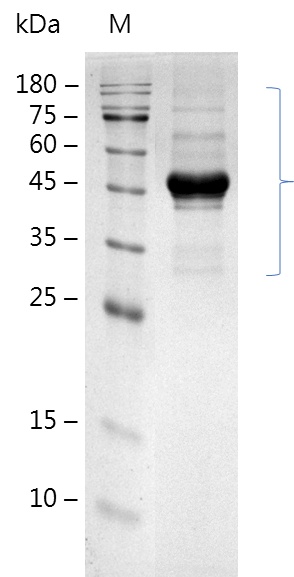
| Purity | > 95% (by SDS-PAGE) |
| Buffer | PBS (pH 7.4) |
| Reconstitution | It is recommended to reconstitute the lyophilized protein in sterile water to a concentration not less than 200 μg/mL and incubate the stock solution for at least 20 min at room temperature to make sure the protein is dissolved completely. |
| Storage Instruction | For long term, lyophilized protein should be stored at -20°C or -80°C. After reconstitution, aliquot and store at -20°C or -80°C for up to one month. Storage in frost free freezers is not recommended. Avoid repeated freeze/thaw cycles. Suggest spin the vial prior to opening. |
| Note | For laboratory research only, not for drug, diagnostic or other use. |
Bioinformation
| Gene Symbol | CA9 |
|---|---|
| Gene Full Name | Carbonic Anhydrase 9 |
| Background | Carbonic anhydrase (CA) is an enzyme that assists rapid inter-conversion of carbon dioxide and water into carbonic acid, protons, and bicarbonate ions. It is abundant in all mammalian tissues. There are many genes that are inducible by hypoxia, via HIF-1 alpha. CA-9 is one of the most inducible genes because of its stability and location within the membrane. Carbonic anhydrases have a widespread role in regulating pH in normal tissues, by regulating hydrogen ion (H+) flux. The pH is important in cell death under hypoxia, thus a blockade of CA 9 results in increased cell death under hypoxia. Therefore, CA-9 has become a reliable histochemical marker of hypoxia. |
| Cellular Localization | Membrane, Nucleus |
| PTM | Asn-346 bears high-mannose type glycan structures. |
Images (1) Click the Picture to Zoom In
-

ARG70819 Human CA9 / Carbonic Anhydrase 9 recombinant protein (His-tagged, C-ter) SDS-PAGE image
SDS-PAGE analysis of ARG70819 Human CA9 / Carbonic Anhydrase 9 recombinant protein (His-tagged, C-ter).