ARG70611
Human CCL13 / MCP4 recombinant protein (Active)
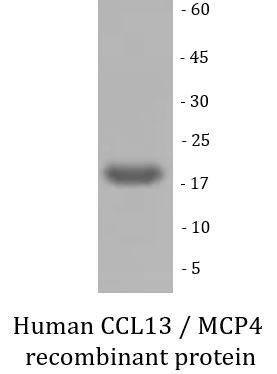
Human CCL13 / MCP4 recombinant protein (Active) for SDS-PAGE
Overview
| Product Description | E. coli expressed, Active Human CCL13 / MCP4 recombinant protein |
|---|---|
| Tested Application | SDS-PAGE |
| Target Name | CCL13 / MCP4 |
| Species | Human |
| A.A. Sequence | Gln24 - Thr98 |
| Expression System | E. coli |
| Activity | Active |
| Activity Note | Determined by a chemotaxis bioassay using human monocytes is in a concentration of 10 - 100 ng/ml. |
| Alternate Names | CCL13; C-C Motif Chemokine Ligand 13; MCP-4; NCC-1; SCYA13; SCYL1; CKb10; Small Inducible Cytokine Subfamily A (Cys-Cys), Member 13; Monocyte Chemoattractant Protein 4; Chemokine (C-C Motif) Ligand 13; Small-Inducible Cytokine A13; CK-Beta-10; MGC17134; NCC1; New CC Chemokine 1; MCP4 |
Properties
| Form | Powder |
|---|---|
| Purification Note | Endotoxin level is less than 0.1 EU/µg of the protein, as determined by the LAL test. |
| Purity | > 96% (by SDS-PAGE or HPLC). |
| Buffer | 20 mM PB, with 150 mM NaCl (pH 7.4) |
| Reconstitution | It is recommended to reconstitute the lyophilized protein in sterile distilled water or aqueous buffer containing 0.1% BSA to a concentration of 0.1-1.0 mg/ml and incubate the stock solution for at least 20 min at room temperature to make sure the protein is dissolved completely. |
| Storage Instruction | For long term, lyophilized protein should be stored at -20°C or -80°C. After reconstitution, aliquot and store at -20°C or -80°C for up to one month. Storage in frost free freezers is not recommended. Avoid repeated freeze/thaw cycles. Suggest spin the vial prior to opening. |
| Note | For laboratory research only, not for drug, diagnostic or other use. |
Bioinformation
| Gene Symbol | CCL13 |
|---|---|
| Gene Full Name | C-C Motif Chemokine Ligand 13 |
| Background | This antimicrobial gene is one of several Cys-Cys (CC) cytokine genes clustered on the q-arm of chromosome 17. Cytokines are a family of secreted proteins involved in immunoregulatory and inflammatory processes. The CC cytokines are proteins characterized by two adjacent cysteines. The cytokine encoded by this gene displays chemotactic activity for monocytes, lymphocytes, basophils and eosinophils, but not neutrophils. This chemokine plays a role in accumulation of leukocytes during inflammation. It may also be involved in the recruitment of monocytes into the arterial wall during artherosclerosis. [provided by RefSeq, Sep 2014] |
| Function | Chemotactic factor that attracts monocytes, lymphocytes, basophils and eosinophils, but not neutrophils. Signals through CCR2B and CCR3 receptors. Plays a role in the accumulation of leukocytes at both sides of allergic and non-allergic inflammation. May be involved in the recruitment of monocytes into the arterial wall during the disease process of atherosclerosis. May play a role in the monocyte attraction in tissues chronically exposed to exogenous pathogens. [UniProt] |
| Cellular Localization | Secreted. [UniProt] |
| PTM | Disulfide bond; Pyrrolidone carboxylic acid. [UniProt] |
Images (1) Click the Picture to Zoom In
-
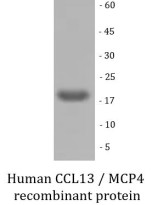
ARG70611 Human CCL13 / MCP4 recombinant protein (Active) SDS-PAGE image
SDS-PAGE analysis of ARG70611 Human CCL13 / MCP4 recombinant protein (Active)