ARG70615
Human CCL23 recombinant protein (Active)
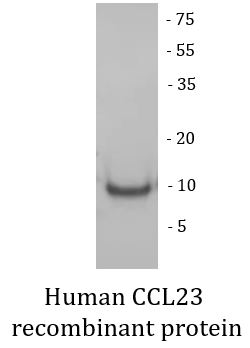
Human CCL23 recombinant protein (Active) for SDS-PAGE
Overview
| Product Description | E. coli expressed, Active Human CCL23 recombinant protein |
|---|---|
| Tested Application | SDS-PAGE |
| Target Name | CCL23 |
| Species | Human |
| A.A. Sequence | Arg24 - Asn94 |
| Expression System | E. coli |
| Activity | Active |
| Activity Note | Determined by a chemotaxis bioassay using human T- lymphocytes is in a concentration of 10 - 50 ng/ml. |
| Alternate Names | Ckb-8-1; CK-beta-8; CKB-8; 27-99; CK-BETA-8; 30-99; SCYA23; CKb8; 22-99; Small-inducible cytokine A23; C-C motif chemokine 23; MPIF-1; hmrp-2a; MIP3; Myeloid progenitor inhibitory factor 1; Macrophage inflammatory protein 3; 19-99; Ckb-8; MIP-3 |
Properties
| Form | Powder |
|---|---|
| Purification Note | Endotoxin level is less than 0.1 EU/µg of the protein, as determined by the LAL test. |
| Purity | > 97% (by SDS-PAGE or HPLC). |
| Buffer | 20 mM PB, with 150 mM NaCl (pH 7.4) |
| Reconstitution | It is recommended to reconstitute the lyophilized protein in sterile distilled water or aqueous buffer containing 0.1% BSA to a concentration of 0.1-1.0 mg/ml and incubate the stock solution for at least 20 min at room temperature to make sure the protein is dissolved completely. |
| Storage Instruction | For long term, lyophilized protein should be stored at -20°C or -80°C. After reconstitution, aliquot and store at -20°C or -80°C for up to one month. Storage in frost free freezers is not recommended. Avoid repeated freeze/thaw cycles. Suggest spin the vial prior to opening. |
| Note | For laboratory research only, not for drug, diagnostic or other use. |
Bioinformation
| Gene Symbol | CCL23 |
|---|---|
| Gene Full Name | chemokine (C-C motif) ligand 23 |
| Background | This gene is one of several chemokine genes clustered on the q-arm of chromosome 17. Chemokines form a superfamily of secreted proteins involved in immunoregulatory and inflammatory processes. The superfamily is divided into four subfamilies based on the arrangement of the N-terminal cysteine residues of the mature peptide. This chemokine, a member of the CC subfamily, displays chemotactic activity on resting T lymphocytes and monocytes, lower activity on neutrophils and no activity on activated T lymphocytes. The protein is also a strong suppressor of colony formation by a multipotential hematopoietic progenitor cell line. In addition, the product of this gene is a potent agonist of the chemokine (C-C motif) receptor 1. Alternative splicing results in multiple transcript variants that encode different isoforms. [provided by RefSeq, Jul 2013] |
| Function | Shows chemotactic activity for monocytes, resting T-lymphocytes, and neutrophils, but not for activated lymphocytes. Inhibits proliferation of myeloid progenitor cells in colony formation assays. This protein can bind heparin. Binds CCR1. CCL23(19-99), CCL23(22-99), CCL23(27-99), CCL23(30-99) are more potent chemoattractants than the small-inducible cytokine A23. [UniProt] |
Images (1) Click the Picture to Zoom In
-
ARG70615 Human CCL23 recombinant protein (Active) SDS-PAGE image
SDS-PAGE analysis of ARG70615 Human CCL23 recombinant protein (Active)