ARG70618
Human CCL27 / CTACK recombinant protein (Active)
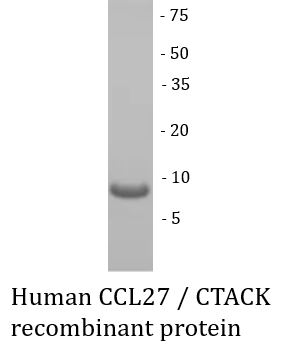
Human CCL27 / CTACK recombinant protein (Active) for SDS-PAGE
Overview
| Product Description | E. coli expressed, Active Human CCL27 / CTACK recombinant protein |
|---|---|
| Tested Application | SDS-PAGE |
| Target Name | CCL27 / CTACK |
| Species | Human |
| A.A. Sequence | Phe25 - Gly112 |
| Expression System | E. coli |
| Activity | Active |
| Activity Note | Determined by a chemotaxis bioassay using CCR10 transfected BaF3 cells is in a concentration range of 10 - 100 ng/ml. |
| Alternate Names | ILC; SCYA27; CTACK; Cutaneous T-cell-attracting chemokine; CTAK; PESKY; ESkine; Skinkine; ESKINE; Small-inducible cytokine A27; IL-11 R-alpha-locus chemokine; C-C motif chemokine 27; ALP; CC chemokine ILC |
Properties
| Form | Powder |
|---|---|
| Purification Note | Endotoxin level is less than 0.01 EU/µg of the protein, as determined by the LAL test. |
| Purity | > 96% (by SDS-PAGE or HPLC). |
| Buffer | PBS(pH 7.0) |
| Reconstitution | It is recommended to reconstitute the lyophilized protein in sterile distilled water or aqueous buffer containing 0.1% BSA to a concentration of 0.1-1.0 mg/ml and incubate the stock solution for at least 20 min at room temperature to make sure the protein is dissolved completely. |
| Storage Instruction | For long term, lyophilized protein should be stored at -20°C or -80°C. After reconstitution, aliquot and store at -20°C or -80°C for up to one month. Storage in frost free freezers is not recommended. Avoid repeated freeze/thaw cycles. Suggest spin the vial prior to opening. |
| Note | For laboratory research only, not for drug, diagnostic or other use. |
Bioinformation
| Gene Symbol | CCL27 |
|---|---|
| Gene Full Name | chemokine (C-C motif) ligand 27 |
| Background | This gene is one of several CC cytokine genes clustered on the p-arm of chromosome 9. Cytokines are a family of secreted proteins involved in immunoregulatory and inflammatory processes. The CC cytokines are proteins characterized by two adjacent cysteines. The protein encoded by this gene is chemotactic for skin-associated memory T lymphocytes. This cytokine may also play a role in mediating homing of lymphocytes to cutaneous sites. It specifically binds to chemokine receptor 10 (CCR10). Studies of a similar murine protein indicate that these protein-receptor interactions have a pivotal role in T cell-mediated skin inflammation. [provided by RefSeq, Sep 2014] |
| Function | Chemotactic factor that attracts skin-associated memory T-lymphocytes. May play a role in mediating homing of lymphocytes to cutaneous sites. Binds to CCR10. [UniProt] |
| Cellular Localization | Secreted. [UniProt] |
| PTM | Disulfide bond. [UniProt] |
Images (1) Click the Picture to Zoom In
-
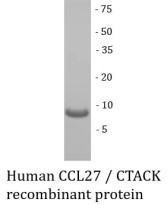
ARG70618 Human CCL27 / CTACK recombinant protein (Active) SDS-PAGE image
SDS-PAGE analysis of ARG70618 Human CCL27 / CTACK recombinant protein (Active)