ARG70720
Human CD147 recombinant protein (His-tagged, C-ter)
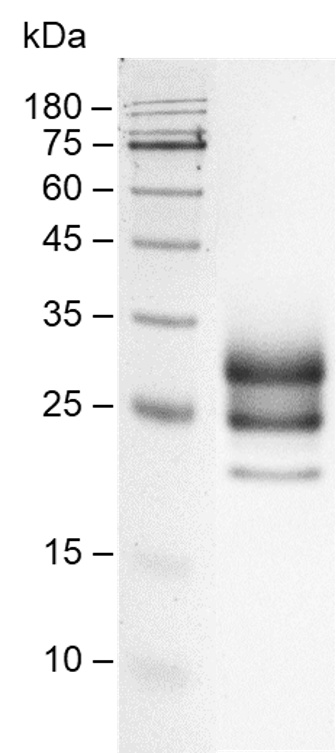
Human CD147 recombinant protein (His-tagged, C-ter) for SDS-PAGE
Overview
| Product Description | CHO expressed, His-tagged (C-ter) CD147 recombinant protein |
|---|---|
| Tested Application | SDS-PAGE |
| Target Name | CD147 |
| Species | Human |
| A.A. Sequence | Ala 22 - His 205 |
| Expression System | CHO |
| Alternate Names | OK; Tumor cell-derived collagenase stimulatory factor; Leukocyte activation antigen M6; TCSF; Extracellular matrix metalloproteinase inducer; OK blood group antigen; CD147; Basigin; M6; EMMPRIN; Collagenase stimulatory factor; CD antigen CD147; 5F7 |
Properties
| Form | Powder |
|---|---|
| Purification Note | Endotoxin level is less than 0.1 EU/µg of the protein, as determined by the LAL test. |
| Purity | > 95% (by SDS-PAGE) |
| Buffer | PBS (pH 7.4) |
| Reconstitution | It is recommended to reconstitute the lyophilized protein in sterile water to a concentration not less than 200 μg/mL and incubate the stock solution for at least 20 min at room temperature to make sure the protein is dissolved completely. |
| Storage Instruction | For long term, lyophilized protein should be stored at -20°C or -80°C. After reconstitution, aliquot and store at -20°C or -80°C for up to one month. Storage in frost free freezers is not recommended. Avoid repeated freeze/thaw cycles. Suggest spin the vial prior to opening. |
| Note | For laboratory research only, not for drug, diagnostic or other use. |
Bioinformation
| Gene Symbol | BSG |
|---|---|
| Gene Full Name | basigin (Ok blood group) |
| Background | CD147 (basigin, neurothelin, OX-47, 5A11, CE9, M6) also known as EMMPRIN (extracellular matrix metalloproteinase inducer) or TCSF (tumour cell-derived collagenase-stimulatory factor) is an ubiquitously expressed cell surface protein with multiple glycosylated forms. The highest level of CD147 expression is on metabolically active cells, such as lymphoblasts, inflammatory cells, brown adipocytes and malignant tumour cells. CD147 has multiple functions, including facilitating of cell surface expression of monocarboxylate transporter proteins and extracellular matrix metalloproteinases, regulation of integrin functions, it plays roles in cell development and activation, fetal development or retinal function. |
| Function | Plays an important role in targeting the monocarboxylate transporters SLC16A1, SLC16A3 and SLC16A8 to the plasma membrane. Plays pivotal roles in spermatogenesis, embryo implantation, neural network formation and tumor progression. Stimulates adjacent fibroblasts to produce matrix metalloproteinases (MMPS). Seems to be a receptor for oligomannosidic glycans. In vitro, promotes outgrowth of astrocytic processes. [UniProt] |
| PTM | N-glycosylated. |
Images (1) Click the Picture to Zoom In
-
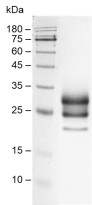
ARG70720 Human CD147 recombinant protein (His-tagged, C-ter) SDS-PAGE image
SDS-PAGE analysis of ARG70720 Human CD147 recombinant protein (His-tagged, C-ter).