ARG70690
Human CD16 recombinant protein (Active) (His-tagged, C-ter)
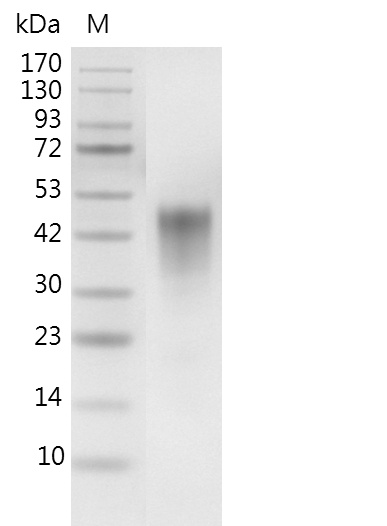
Human CD16 recombinant protein (Active) (His-tagged, C-ter) for SDS-PAGE
Overview
| Product Description | CHO expressed, His-tagged (C-ter) Active CD16 recombinant protein |
|---|---|
| Tested Application | SDS-PAGE |
| Target Name | CD16 |
| Species | Human |
| A.A. Sequence | Gly17 - Gln208 |
| Expression System | CHO |
| Activity | Active |
| Activity Note | Determinedd by its ability to bind human IgG in functional ELISA. Immobilized human IgG at 0.5 μg/mL (100μL/well) can bind Recombinant Human CD16A Protein. |
| Alternate Names | FCRIIIA; FcRIIIa; CD antigen CD16a; Fc-gamma RIII-alpha; FCR-10; FcR-10; FCRIII; FCG3; Low affinity immunoglobulin gamma Fc region receptor III-A; FCGRIII; CD16; Fc-gamma RIIIa; IgG Fc receptor III-2; IMD20; CD16A; IGFR3; CD16a antigen; FCGR3; FcRIII; Fc-gamma RIII |
Properties
| Form | Powder |
|---|---|
| Purification Note | Endotoxin level is less than 0.1 EU/µg of the protein, as determined by the LAL test. |
| Purity | > 95% (by SDS-PAGE); > 90% (by HPLC) |
| Buffer | PBS (pH 7.4) |
| Reconstitution | It is recommended to reconstitute the lyophilized protein in sterile water to a concentration not less than 200 μg/mL and incubate the stock solution for at least 20 min at room temperature to make sure the protein is dissolved completely. |
| Storage Instruction | For long term, lyophilized protein should be stored at -20°C or -80°C. After reconstitution, aliquot and store at -20°C or -80°C for up to one month. Storage in frost free freezers is not recommended. Avoid repeated freeze/thaw cycles. Suggest spin the vial prior to opening. |
| Note | For laboratory research only, not for drug, diagnostic or other use. |
Bioinformation
| Gene Symbol | FCGR3A |
|---|---|
| Gene Full Name | Fc fragment of IgG, low affinity IIIa, receptor (CD16a) |
| Background | This gene encodes a receptor for the Fc portion of immunoglobulin G, and it is involved in the removal of antigen-antibody complexes from the circulation, as well as other other antibody-dependent responses. This gene (FCGR3A) is highly similar to another nearby gene (FCGR3B) located on chromosome 1. The receptor encoded by this gene is expressed on natural killer (NK) cells as an integral membrane glycoprotein anchored through a transmembrane peptide, whereas FCGR3B is expressed on polymorphonuclear neutrophils (PMN) where the receptor is anchored through a phosphatidylinositol (PI) linkage. Mutations in this gene have been linked to susceptibility to recurrent viral infections, susceptibility to systemic lupus erythematosus, and alloimmune neonatal neutropenia. Alternatively spliced transcript variants encoding different isoforms have been found for this gene. [provided by RefSeq, Jul 2008] |
| Function | Receptor for the Fc region of IgG. Binds complexed or aggregated IgG and also monomeric IgG. Mediates antibody-dependent cellular cytotoxicity (ADCC) and other antibody-dependent responses, such as phagocytosis. [UniProt] |
| Cellular Localization | Cell membrane; Single-pass type I membrane protein. Secreted. Note=Exists also as a soluble receptor. [UniProt] |
| PTM | Glycosylated. Contains high mannose- and complex-type oligosaccharides. Glycosylation at Asn-180 is mandatory for high affinity binding to the Fc and for discrimination between fucosylated and afucosylated IgG glycoforms. The soluble form is produced by a proteolytic cleavage. [UniProt] |
Images (1) Click the Picture to Zoom In
-
ARG70690 Human CD16 recombinant protein (Active) (His-tagged, C-ter) SDS-PAGE image
SDS-PAGE analysis of ARG70690 Human CD16 recombinant protein (Active) (His-tagged, C-ter).