ARG70892
Human CD162 / PSGL1 recombinant protein (hFc-tagged and His-tagged, C-ter)
Human CD162 / PSGL1 recombinant protein (hFc-tagged and His-tagged, C-ter) for SDS-PAGE
Overview
| Product Description | HEK293 expressed, Human hFc-tagged and His-tagged (C-ter) CD162 / PSGL1 recombinant protein |
|---|---|
| Tested Application | SDS-PAGE |
| Target Name | CD162 / PSGL1 |
| Species | Human |
| A.A. Sequence | Thr81 - Glu170 |
| Expression System | HEK293 |
| Alternate Names | SELPLG; Selectin P ligand; PSGL1; P-selectin glycoprotein ligand 1; PSGL-1; CD162; CLA; CD antigen CD162 |
Properties
| Form | Powder |
|---|---|
| Buffer | PBS |
| Reconstitution | It is recommended to reconstitute the lyophilized protein in sterile water to a concentration approximately 1 mg/mL and incubate the stock solution for at least 20 min at room temperature to make sure the protein is dissolved completely. |
| Storage Instruction | For long term, lyophilized protein should be stored at -20°C or -80°C, protected from light and moisture, for up to 12 months. After reconstitution , aliquot and store at 2 to 8°C for up to 2 days, or at -20°C or -80°C for up to 3 months Storage in frost free freezers is not recommended. Avoid repeated freeze/thaw cycles. Suggest spin the vial prior to opening. |
Bioinformation
| Gene Symbol | SELPLG |
|---|---|
| Gene Full Name | Selectin P ligand |
| Background | CD162 (P-selectin glycoprotein ligand-1, PSGL-1) is a sialomucin constitutively expressed as a disulfide-linked homodimer of two 120 kDa subunits on the surface of circulating leukocytes. CD162 serves as a ligand for P- E- and L-selectin, with the highest affinity for P-selectin. It is thus involved in leukocyte rolling at the endothelial surfaces, prerequisite for firm leukocyte adhesion and subsequent transendothelial migration. CD162 also mediates leukocyte-platelet adhesion and interleukocyte contacts. Whereas serving as an adhession molecule on mature leukocytes, CD162 is a potent negative regulator of human hematopoietic progenitors. |
| Function | A SLe(x)-type proteoglycan, which through high affinity, calcium-dependent interactions with E-, P- and L-selectins, mediates rapid rolling of leukocytes over vascular surfaces during the initial steps in inflammation. Critical for the initial leukocyte capture. [UniProt]. [UniProt] |
| Cellular Localization | Cell membrane. [UniProt] |
| PTM | Displays complex, core-2, sialylated and fucosylated O-linked oligosaccharides, at least some of which appear to contain poly-N-acetyllactosamine with varying degrees of substitution. Mainly disialylated or neutral forms of the core-2 tetrasaccharide, Galbeta1-->4GlcNAcbeta1-->6(Galbeta1-->3)GalNAcOH. The GlcN:GalN ratio is approximately 2:1 and the Man:Fuc ratio 3:5. Contains about 14% fucose with alpha-1,3 linkage present in two forms: One species is a disialylated, monofucosylated glycan, and the other, a monosialylated, trifucosylated glycan with a polylactosamine backbone. The fucosylated forms carry the Lewis antigen and are important for interaction with selectins and for functioning in leukocyte rolling. The modification containing the sialyl Lewis X glycan is on Thr-57. No sulfated O-glycans. Some N-glycosylation. Sulfation, in conjunction with the SLe(x)-containing glycan, is necessary for P- and L-selectin binding. High affinity P-selectin binding has a preferred requirement for the isomer sulfated on both Tyr-48 and Tyr-51, whereas L-selectin binding requires predominantly sulfation on Tyr-51 with sulfation on Tyr-48 playing only a minor role. These sulfations play an important role in L- and P-selectin-mediated neutrophil recruitment, and leukocyte rolling. [UniProt] |
Images (1) Click the Picture to Zoom In
-
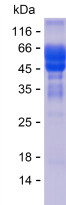
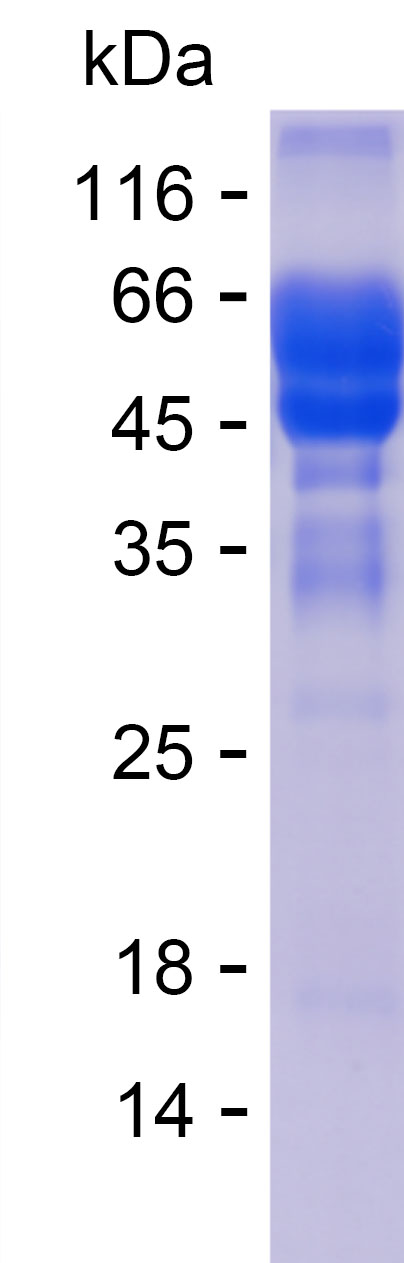
ARG70892 Human CD162 / PSGL1 recombinant protein (hFc-tagged and His-tagged, C-ter) SDS-PAGE image
SDS-PAGE analysis of ARG70892 Human CD162 / PSGL1 recombinant protein (hFc-tagged and His-tagged, C-ter).