ARG70886
Human CD204 / MSR1 recombinant protein (His-tagged, C-ter)
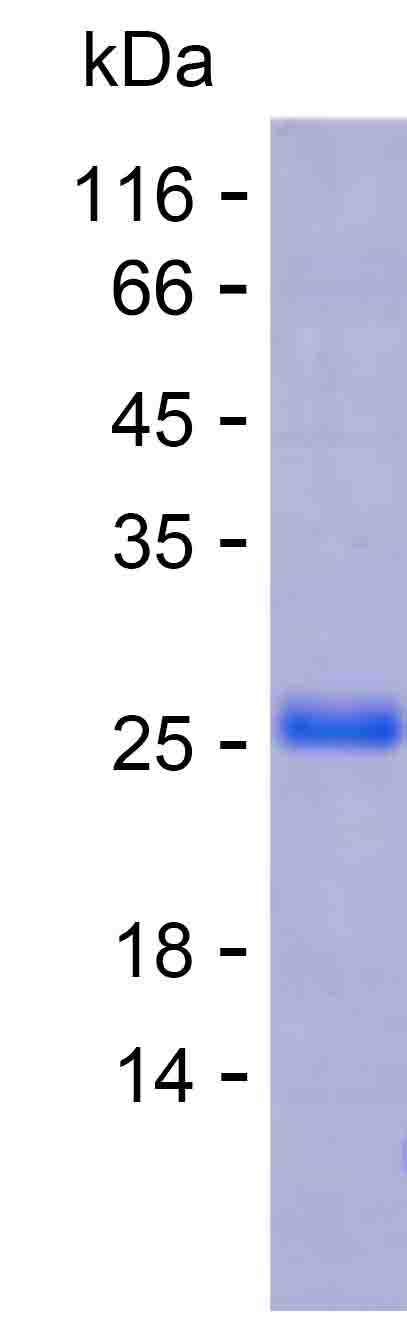
Human CD204 / MSR1 recombinant protein (His-tagged, C-ter) for SDS-PAGE
Overview
| Product Description | E. coli expressed, His-tagged (C-ter) CD204 / MSR1 recombinant protein |
|---|---|
| Tested Application | SDS-PAGE |
| Target Name | CD204 / MSR1 |
| Species | Human |
| A.A. Sequence | Lys81 - Leu270 |
| Expression System | E. coli |
| Alternate Names | Macrophage scavenger receptor types I and II; SR-A; SCARA1; Macrophage acetylated LDL receptor I and II; SRA; CD antigen CD204; Scavenger receptor class A member 1; CD204; phSR1; phSR2 |
Properties
| Form | Powder |
|---|---|
| Buffer | PBS |
| Reconstitution | It is recommended to reconstitute the lyophilized protein in sterile water to a concentration approximately 1 mg/mL and incubate the stock solution for at least 20 min at room temperature to make sure the protein is dissolved completely. |
| Storage Instruction | For long term, lyophilized protein should be stored at -20°C or -80°C, protected from light and moisture, for up to 12 months. After reconstitution , aliquot and store at 2 to 8°C for up to 2 days, or at -20°C or -80°C for up to 3 months Storage in frost free freezers is not recommended. Avoid repeated freeze/thaw cycles. Suggest spin the vial prior to opening. |
Bioinformation
| Gene Symbol | Msr1 |
|---|---|
| Gene Full Name | macrophage scavenger receptor 1 |
| Background | This gene encodes the class A macrophage scavenger receptors, which include three different types (1, 2, 3) generated by alternative splicing of this gene. These receptors or isoforms are macrophage-specific trimeric integral membrane glycoproteins and have been implicated in many macrophage-associated physiological and pathological processes including atherosclerosis, Alzheimer's disease, and host defense. The isoforms type 1 and type 2 are functional receptors and are able to mediate the endocytosis of modified low density lipoproteins (LDLs). The isoform type 3 does not internalize modified LDL (acetyl-LDL) despite having the domain shown to mediate this function in the types 1 and 2 isoforms. It has an altered intracellular processing and is trapped within the endoplasmic reticulum, making it unable to perform endocytosis. The isoform type 3 can inhibit the function of isoforms type 1 and type 2 when co-expressed, indicating a dominant negative effect and suggesting a mechanism for regulation of scavenger receptor activity in macrophages. [provided by RefSeq, Jul 2008] |
| Function | Membrane glycoproteins implicated in the pathologic deposition of cholesterol in arterial walls during atherogenesis. Two types of receptor subunits exist. These receptors mediate the endocytosis of a diverse group of macromolecules, including modified low density lipoproteins (LDL). Isoform III does not internalize acetylated LDL. [UniProt] |
Images (1) Click the Picture to Zoom In
-
ARG70886 Human CD204 / MSR1 recombinant protein (His-tagged, C-ter) SDS-PAGE image
SDS-PAGE analysis of ARG70886 Human CD204 / MSR1 recombinant protein (His-tagged, C-ter).