ARG70801
Human CD319 / SLAMF7 recombinant protein (Active) (His-tagged, C-ter)
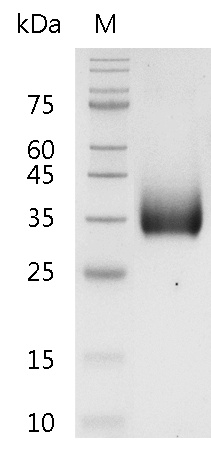
Human CD319 / SLAMF7 recombinant protein (Active) (His-tagged, C-ter) for SDS-PAGE
Overview
| Product Description | HEK293 expressed, His-tagged (C-ter) Active CD319 / SLAMF7 recombinant protein |
|---|---|
| Tested Application | SDS-PAGE |
| Target Name | CD319 / SLAMF7 |
| Species | Human |
| A.A. Sequence | Met1 - Met226 |
| Expression System | HEK293 |
| Activity | Active |
| Activity Note | Determinedd by its ability to bind Human SLAMF7 Antibody in functional ELISA. Immobilized Recombinant human SLAMF7 Protein at 2 μg/mL (50 μL/well) can bind Human SLAMF7 Antibody. |
| Alternate Names | CD2-like receptor-activating cytotoxic cells; Protein 19A; CS1; Membrane protein FOAP-12; 19A; CD antigen CD319; SLAM family member 7; CD319; CD2 subset 1; Novel Ly9; CRACC |
Properties
| Form | Powder |
|---|---|
| Purification Note | Endotoxin level is less than 0.1 EU/µg of the protein, as determined by the LAL test. |
| Purity | > 85% (by SDS-PAGE) |
| Buffer | PBS (pH 7.4) |
| Reconstitution | It is recommended to reconstitute the lyophilized protein in 4 mM HCl to a concentration not less than 200 μg/mL and incubate the stock solution for at least 20 min at room temperature to make sure the protein is dissolved completely. |
| Storage Instruction | For long term, lyophilized protein should be stored at -20°C or -80°C. After reconstitution, aliquot and store at -20°C or -80°C for up to one month. Storage in frost free freezers is not recommended. Avoid repeated freeze/thaw cycles. Suggest spin the vial prior to opening. |
| Note | For laboratory research only, not for drug, diagnostic or other use. |
Bioinformation
| Gene Symbol | SLAMF7 |
|---|---|
| Gene Full Name | SLAM family member 7 |
| Function | Self-ligand receptor of the signaling lymphocytic activation molecule (SLAM) family. SLAM receptors triggered by homo- or heterotypic cell-cell interactions are modulating the activation and differentiation of a wide variety of immune cells and thus are involved in the regulation and interconnection of both innate and adaptive immune response. Activities are controlled by presence or absence of small cytoplasmic adapter proteins, SH2D1A/SAP and/or SH2D1B/EAT-2. Isoform 1 mediates NK cell activation through a SH2D1A-independent extracellular signal-regulated ERK-mediated pathway (PubMed:11698418). Positively regulates NK cell functions by a mechanism dependent on phosphorylated SH2D1B. Downstream signaling implicates PLCG1, PLCG2 and PI3K (PubMed:16339536). In addition to heterotypic NK cells-target cells interactions also homotypic interactions between NK cells may contribute to activation. However, in the absence of SH2D1B, inhibits NK cell function. Acts also inhibitory in T-cells (By similarity). May play a role in lymphocyte adhesion (PubMed:11802771). In LPS-activated monocytes negatively regulates production of proinflammatory cytokines (PubMed:23695528). Isoform 3 does not mediate any NK cell activation. [UniProt] |
| Cellular Localization | Membrane; Single-pass type I membrane protein. [UniProt] |
Images (1) Click the Picture to Zoom In
-
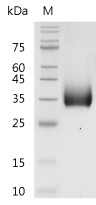
ARG70801 Human CD319 / SLAMF7 recombinant protein (Active) (His-tagged, C-ter) SDS-PAGE image
SDS-PAGE analysis of ARG70801 Human CD319 / SLAMF7 recombinant protein (Active) (His-tagged, C-ter).