ARG70677
Human CD38 recombinant protein (His-tagged, C-ter)
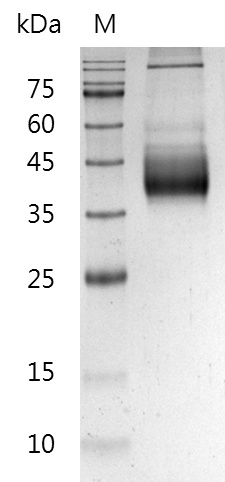
Human CD38 recombinant protein (His-tagged, C-ter) for SDS-PAGE
Overview
| Product Description | CHO expressed, His-tagged (C-ter) CD38 recombinant protein |
|---|---|
| Tested Application | SDS-PAGE |
| Target Name | CD38 |
| Species | Human |
| A.A. Sequence | Val 43 - Ile 300 |
| Expression System | CHO |
| Alternate Names | cADPr hydrolase 1; ADPRC 1; EC 3.2.2.6; 2'-phospho-ADP-ribosyl cyclase/2'-phospho-cyclic-ADP-ribose transferase; Cyclic ADP-ribose hydrolase 1; ADPRC1; EC 2.4.99.20; ADP-ribosyl cyclase 1; 2'-phospho-cyclic-ADP-ribose transferase; CD antigen CD38; T10; 2'-phospho-ADP-ribosyl cyclase; ADP-ribosyl cyclase/cyclic ADP-ribose hydrolase 1 |
Properties
| Form | Powder |
|---|---|
| Purification Note | Endotoxin level is less than 0.1 EU/µg of the protein, as determined by the LAL test. |
| Purity | > 85% (by SDS-PAGE gel and HPLC analyses. |
| Buffer | PBS (pH 7.4) |
| Reconstitution | It is recommended to reconstitute the lyophilized protein in sterile water to a concentration not less than 200 μg/mL and incubate the stock solution for at least 20 min at room temperature to make sure the protein is dissolved completely. |
| Storage Instruction | For long term, lyophilized protein should be stored at -20°C or -80°C. After reconstitution, aliquot and store at -20°C or -80°C for up to one month. Storage in frost free freezers is not recommended. Avoid repeated freeze/thaw cycles. Suggest spin the vial prior to opening. |
| Note | For laboratory research only, not for drug, diagnostic or other use. |
Bioinformation
| Gene Symbol | CD38 |
|---|---|
| Gene Full Name | CD38 antigen |
| Background | The protein encoded by this gene is a non-lineage-restricted, type II transmembrane glycoprotein that synthesizes and hydrolyzes cyclic adenosine 5'-diphosphate-ribose, an intracellular calcium ion mobilizing messenger. The release of soluble protein and the ability of membrane-bound protein to become internalized indicate both extracellular and intracellular functions for the protein. This protein has an N-terminal cytoplasmic tail, a single membrane-spanning domain, and a C-terminal extracellular region with four N-glycosylation sites. Crystal structure analysis demonstrates that the functional molecule is a dimer, with the central portion containing the catalytic site. It is used as a prognostic marker for patients with chronic lymphocytic leukemia. Alternative splicing results in multiple transcript variants. [provided by RefSeq, Sep 2015] |
| Function | Synthesizes the second messagers cyclic ADP-ribose and nicotinate-adenine dinucleotide phosphate, the former a second messenger for glucose-induced insulin secretion. Also has cADPr hydrolase activity. Also moonlights as a receptor in cells of the immune system. [UniProt] |
Images (1) Click the Picture to Zoom In
-
ARG70677 Human CD38 recombinant protein (His-tagged, C-ter) SDS-PAGE image
SDS-PAGE analysis of ARG70677 Human CD38 recombinant protein (His-tagged, C-ter).