ARG70686
Human CD40 recombinant protein (Active) (His-tagged, C-ter)
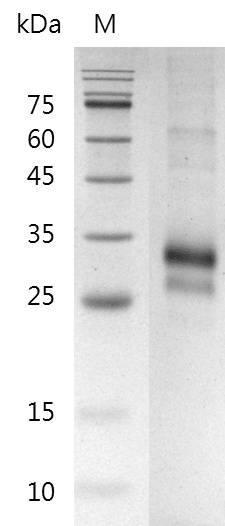
Human CD40 recombinant protein (Active) (His-tagged, C-ter) for SDS-PAGE
Overview
| Product Description | CHO expressed, His-tagged (C-ter) Active CD40 recombinant protein |
|---|---|
| Tested Application | SDS-PAGE |
| Target Name | CD40 |
| Species | Human |
| A.A. Sequence | Glu21 - Arg193 |
| Expression System | CHO |
| Activity | Active |
| Activity Note | Determinedd by its ability to bind human CD40L in functional ELISA. Immobilized Recombinant human CD40L Protein at 1 μg/mL (100 μL/well) can bind Recombinant Human CD40 Protein. |
| Alternate Names | CDw40; CD antigen CD40; Tumor necrosis factor receptor superfamily member 5; Bp50; CD40L receptor; CDW40; TNFRSF5; p50; B-cell surface antigen CD40 |
Properties
| Form | Powder |
|---|---|
| Purification Note | Endotoxin level is less than 0.1 EU/µg of the protein, as determined by the LAL test. |
| Purity | > 90% (by SDS-PAGE) |
| Buffer | PBS (pH 7.4) |
| Reconstitution | It is recommended to reconstitute the lyophilized protein in sterile water to a concentration not less than 200 μg/mL and incubate the stock solution for at least 20 min at room temperature to make sure the protein is dissolved completely. |
| Storage Instruction | For long term, lyophilized protein should be stored at -20°C or -80°C. After reconstitution, aliquot and store at -20°C or -80°C for up to one month. Storage in frost free freezers is not recommended. Avoid repeated freeze/thaw cycles. Suggest spin the vial prior to opening. |
| Note | For laboratory research only, not for drug, diagnostic or other use. |
Bioinformation
| Gene Symbol | CD40 |
|---|---|
| Gene Full Name | CD40 Molecule |
| Background | CD40 is a type I membrane protein found on the surface of B cells and primary carcinomas. It belongs to the TNF-R family. CD40 serves as the receptor for CD40 ligand (CD40L), a cytokine expressed on the cell surface of T cells. CD40 plays a critical role in B cell proliferation, antibody class switching, modulation of apoptosis in the germinal center through interaction with T cells expressing CD40L, and activation of CD4+ T cells. In non-hemopoitic cells such as epidermal basal cells, CD40 ligation serves as the signal for inhibition of cell growth and induction of differentiation. The cytoplasmic domain of CD40 interacts with TRAF6, a TNFR associated factor homolog that mediates signaling from CD40. Ligation of CD40 with its ligand preferentially induces stress-activated protein kinases in B lymphocytes. |
Images (1) Click the Picture to Zoom In
-
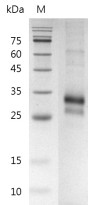
ARG70686 Human CD40 recombinant protein (Active) (His-tagged, C-ter) SDS-PAGE image
SDS-PAGE analysis of ARG70686 Human CD40 recombinant protein (Active) (His-tagged, C-ter).