ARG70734
Human CD47 recombinant protein (Active) (His-tagged, C-ter)
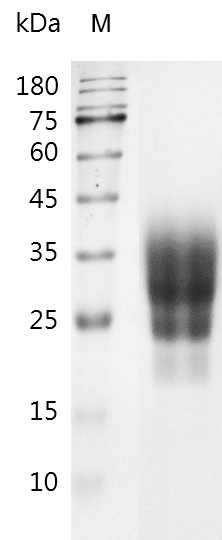
Human CD47 recombinant protein (Active) (His-tagged, C-ter) for SDS-PAGE
Overview
| Product Description | CHO expressed, His-tagged (C-ter) Active CD47 recombinant protein |
|---|---|
| Tested Application | SDS-PAGE |
| Target Name | CD47 |
| Species | Human |
| A.A. Sequence | Gln19 - Pro139 |
| Expression System | CHO |
| Activity | Active |
| Activity Note | Determinedd by its ability to bind human SIRP Alpha in functional ELISA. Immobilized Recombinant human SIRP Alpha Protein at 2 μg/mL (100μL/well) can bind Recombinant Human CD47 Protein. |
| Alternate Names | Leukocyte surface antigen CD47; CD antigen CD47; Antigenic surface determinant protein OA3; MER6; OA3; Protein MER6; IAP; Integrin-associated protein |
Properties
| Form | Powder |
|---|---|
| Purification Note | Endotoxin level is less than 0.1 EU/µg of the protein, as determined by the LAL test. |
| Purity | > 95% (by SDS-PAGE) |
| Buffer | PBS (pH 7.4) |
| Reconstitution | It is recommended to reconstitute the lyophilized protein in sterile water to a concentration not less than 200 μg/mL and incubate the stock solution for at least 20 min at room temperature to make sure the protein is dissolved completely. |
| Storage Instruction | For long term, lyophilized protein should be stored at -20°C or -80°C. After reconstitution, aliquot and store at -20°C or -80°C for up to one month. Storage in frost free freezers is not recommended. Avoid repeated freeze/thaw cycles. Suggest spin the vial prior to opening. |
| Note | For laboratory research only, not for drug, diagnostic or other use. |
Bioinformation
| Gene Symbol | CD47 |
|---|---|
| Gene Full Name | CD47 molecule |
| Background | This gene encodes a membrane protein, which is involved in the increase in intracellular calcium concentration that occurs upon cell adhesion to extracellular matrix. The encoded protein is also a receptor for the C-terminal cell binding domain of thrombospondin, and it may play a role in membrane transport and signal transduction. This gene has broad tissue distribution, and is reduced in expression on Rh erythrocytes. Alternatively spliced transcript variants have been found for this gene. [provided by RefSeq, Jul 2010] |
| Function | Has a role in both cell adhesion by acting as an adhesion receptor for THBS1 on platelets, and in the modulation of integrins. Plays an important role in memory formation and synaptic plasticity in the hippocampus (By similarity). Receptor for SIRPA, binding to which prevents maturation of immature dendritic cells and inhibits cytokine production by mature dendritic cells. Interaction with SIRPG mediates cell-cell adhesion, enhances superantigen-dependent T-cell-mediated proliferation and costimulates T-cell activation. May play a role in membrane transport and/or integrin dependent signal transduction. May prevent premature elimination of red blood cells. May be involved in membrane permeability changes induced following virus infection. [UniProt] |
Images (1) Click the Picture to Zoom In
-
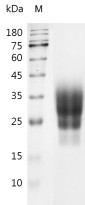
ARG70734 Human CD47 recombinant protein (Active) (His-tagged, C-ter) SDS-PAGE image
SDS-PAGE analysis of ARG70734 Human CD47 recombinant protein (Active) (His-tagged, C-ter).