ARG70668
Human CD63 recombinant protein (Active) (His-tagged, C-ter)
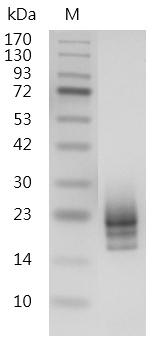
Human CD63 recombinant protein (Active) (His-tagged, C-ter) for SDS-PAGE
Overview
| Product Description | CHO expressed, His-tagged (C-ter) Active CD63 recombinant protein |
|---|---|
| Tested Application | SDS-PAGE |
| Target Name | CD63 |
| Species | Human |
| A.A. Sequence | Ala 103 - Val 203 |
| Expression System | CHO |
| Activity | Active |
| Activity Note | Determinedd by flow cytometry for its ability to bind a ligand expressed in U-937 human histiocytic lymphoma cells. |
| Alternate Names | Tspan-30; CD63 antigen; Tetraspanin-30; CD antigen CD63; Lysosomal-associated membrane protein 3; OMA81H; Ocular melanoma-associated antigen; Granulophysin; TSPAN30; Melanoma-associated antigen ME491; MLA1; LAMP-3; ME491 |
Properties
| Form | Powder |
|---|---|
| Purification Note | Endotoxin level is less than 0.1 EU/µg of the protein, as determined by the LAL test. |
| Purity | > 95% (by SDS-PAGE); > 90% (by HPLC) |
| Buffer | PBS (pH 7.4) |
| Reconstitution | It is recommended to reconstitute the lyophilized protein in sterile water to a concentration not less than 200 μg/mL and incubate the stock solution for at least 20 min at room temperature to make sure the protein is dissolved completely. |
| Storage Instruction | For long term, lyophilized protein should be stored at -20°C or -80°C. After reconstitution, aliquot and store at -20°C or -80°C for up to one month. Storage in frost free freezers is not recommended. Avoid repeated freeze/thaw cycles. Suggest spin the vial prior to opening. |
| Note | For laboratory research only, not for drug, diagnostic or other use. |
Bioinformation
| Gene Symbol | CD63 |
|---|---|
| Gene Full Name | CD63 molecule |
| Background | CD63 (LAMP-3, lysosome-associated membrane protein-3), a glycoprotein of tetraspanin family, is present in late endosomes, lysosomes and secretory vesicles of various cell types. It is also present in the plasma membrane, usually following cell activation. Hence, it has become an widely used basophil activation marker. In mast cells, however, CD63 exposition does not need their activation. CD63 interacts with integrins and affects phagocytosis and cell migration, it is also involved in H/K-ATPase trafficking regulation of ROMK1 channels. CD63 also serves as a T-cell costimulation molecule. Expression of CD63 can be used for predicting the prognosis in earlier stages of carcinomas. |
| Function | Functions as cell surface receptor for TIMP1 and plays a role in the activation of cellular signaling cascades. Plays a role in the activation of ITGB1 and integrin signaling, leading to the activation of AKT, FAK/PTK2 and MAP kinases. Promotes cell survival, reorganization of the actin cytoskeleton, cell adhesion, spreading and migration, via its role in the activation of AKT and FAK/PTK2. Plays a role in VEGFA signaling via its role in regulating the internalization of KDR/VEGFR2. Plays a role in intracellular vesicular transport processes, and is required for normal trafficking of the PMEL luminal domain that is essential for the development and maturation of melanocytes. Plays a role in the adhesion of leukocytes onto endothelial cells via its role in the regulation of SELP trafficking. May play a role in mast cell degranulation in response to Ms4a2/FceRI stimulation, but not in mast cell degranulation in response to other stimuli. [UniProt] |
| PTM | Palmitoylated at a low, basal level in unstimulated platelets. The level of palmitoylation increases when platelets are activated by thrombin (in vitro). |
Images (1) Click the Picture to Zoom In
-
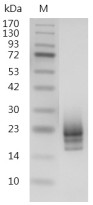
ARG70668 Human CD63 recombinant protein (Active) (His-tagged, C-ter) SDS-PAGE image
SDS-PAGE analysis of ARG70668 Human CD63 recombinant protein (Active) (His-tagged, C-ter).