ARG70735
Human CD79a recombinant protein (His-tagged, C-ter)
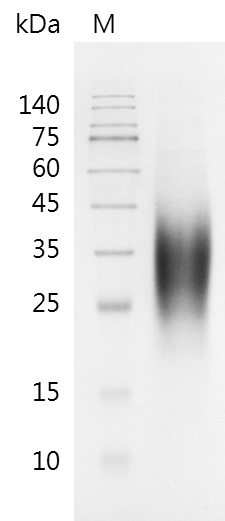
Human CD79a recombinant protein (His-tagged, C-ter) for SDS-PAGE
Overview
| Product Description | CHO expressed, His-tagged (C-ter) CD79a recombinant protein |
|---|---|
| Tested Application | SDS-PAGE |
| Target Name | CD79a |
| Species | Human |
| A.A. Sequence | Leu33 - Arg143 |
| Expression System | CHO |
| Alternate Names | Surface IgM-associated protein; B-cell antigen receptor complex-associated protein alpha chain; Membrane-bound immunoglobulin-associated protein; Ig-alpha; MB-1 membrane glycoprotein; MB-1; IGA; CD antigen CD79a |
Properties
| Form | Powder |
|---|---|
| Purification Note | Endotoxin level is less than 0.1 EU/µg of the protein, as determined by the LAL test. |
| Purity | > 95% (by SDS-PAGE) |
| Buffer | PBS (pH 7.4) |
| Reconstitution | It is recommended to reconstitute the lyophilized protein in sterile water to a concentration not less than 200 μg/mL and incubate the stock solution for at least 20 min at room temperature to make sure the protein is dissolved completely. |
| Storage Instruction | For long term, lyophilized protein should be stored at -20°C or -80°C. After reconstitution, aliquot and store at -20°C or -80°C for up to one month. Storage in frost free freezers is not recommended. Avoid repeated freeze/thaw cycles. Suggest spin the vial prior to opening. |
| Note | For laboratory research only, not for drug, diagnostic or other use. |
Bioinformation
| Gene Symbol | CD79A |
|---|---|
| Gene Full Name | CD79a molecule, immunoglobulin-associated alpha |
| Background | CD79a: The B lymphocyte antigen receptor is a multimeric complex that includes the antigen-specific component, surface immunoglobulin (Ig). Surface Ig non-covalently associates with two other proteins, Ig-alpha and Ig-beta, which are necessary for expression and function of the B-cell antigen receptor. This gene encodes the Ig-alpha protein of the B-cell antigen component. Alternatively spliced transcript variants encoding different isoforms have been described. [provided by RefSeq, Jul 2008] |
| Function | CD79a is required in cooperation with CD79b for initiation of the signal transduction cascade activated by binding of antigen to the B-cell antigen receptor complex (BCR) which leads to internalization of the complex, trafficking to late endosomes and antigen presentation. Also required for BCR surface expression and for efficient differentiation of pro- and pre-B-cells. Stimulates SYK autophosphorylation and activation. Binds to BLNK, bringing BLNK into proximity with SYK and allowing SYK to phosphorylate BLNK. Also interacts with and increases activity of some Src-family tyrosine kinases. Represses BCR signaling during development of immature B-cells. [UniProt] |
| PTM | Phosphorylated on tyrosine, serine and threonine residues upon B-cell activation. Phosphorylation of tyrosine residues by Src-family kinases is an early and essential feature of the BCR signaling cascade. The phosphorylated tyrosines serve as docking sites for SH2-domain containing kinases, leading to their activation which in turn leads to phosphorylation of downstream targets. Phosphorylated by LYN. Phosphorylation of serine and threonine residues may prevent subsequent tyrosine phosphorylation. Arginine methylation in the ITAM domain may interfere with the binding of SYK. It promotes signals leading to B-cell differentiation (By similarity). |
Images (1) Click the Picture to Zoom In
-
ARG70735 Human CD79a recombinant protein (His-tagged, C-ter) SDS-PAGE image
SDS-PAGE analysis of ARG70735 Human CD79a recombinant protein (His-tagged, C-ter).