ARG70708
Human CD85k / ILT3 recombinant protein (Active) (His-tagged, C-ter)
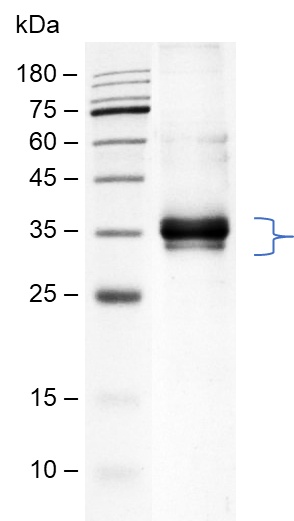
Human CD85k / ILT3 recombinant protein (Active) (His-tagged, C-ter) for SDS-PAGE
Overview
| Product Description | CHO expressed, His-tagged (C-ter) Active CD85k / ILT3 recombinant protein |
|---|---|
| Tested Application | SDS-PAGE |
| Target Name | CD85k / ILT3 |
| Species | Human |
| A.A. Sequence | Gln 22 - Glu259 |
| Expression System | CHO |
| Activity | Active |
| Activity Note | Determinedd by its ability to bind human LILRB4 Antibody in functional ELISA. Immobilized Recombinant human LILRB4 Protein can bind human LILRB4 Antibody. |
| Alternate Names | ILT3; CD85 antigen-like family member K; LIR-5; Immunoglobulin-like transcript 3; Leukocyte immunoglobulin-like receptor subfamily B member 4; ILT-3; LIR5; Monocyte inhibitory receptor HM18; CD antigen CD85k; CD85K; Leukocyte immunoglobulin-like receptor 5 |
Properties
| Form | Powder |
|---|---|
| Purification Note | Endotoxin level is less than 0.1 EU/µg of the protein, as determined by the LAL test. |
| Purity | > 95% (by SDS-PAGE) |
| Buffer | PBS (pH 7.4) |
| Reconstitution | It is recommended to reconstitute the lyophilized protein in sterile water to a concentration not less than 200 μg/mL and incubate the stock solution for at least 20 min at room temperature to make sure the protein is dissolved completely. |
| Storage Instruction | For long term, lyophilized protein should be stored at -20°C or -80°C. After reconstitution, aliquot and store at -20°C or -80°C for up to one month. Storage in frost free freezers is not recommended. Avoid repeated freeze/thaw cycles. Suggest spin the vial prior to opening. |
| Note | For laboratory research only, not for drug, diagnostic or other use. |
Bioinformation
| Gene Symbol | LILRB4 |
|---|---|
| Gene Full Name | leukocyte immunoglobulin-like receptor, subfamily B (with TM and ITIM domains), member 4 |
| Background | This gene is a member of the leukocyte immunoglobulin-like receptor (LIR) family, which is found in a gene cluster at chromosomal region 19q13.4. The encoded protein belongs to the subfamily B class of LIR receptors which contain two or four extracellular immunoglobulin domains, a transmembrane domain, and two to four cytoplasmic immunoreceptor tyrosine-based inhibitory motifs (ITIMs). The receptor is expressed on immune cells where it binds to MHC class I molecules on antigen-presenting cells and transduces a negative signal that inhibits stimulation of an immune response. The receptor can also function in antigen capture and presentation. It is thought to control inflammatory responses and cytotoxicity to help focus the immune response and limit autoreactivity. Multiple transcript variants encoding different isoforms have been found for this gene. [provided by RefSeq, Jul 2008] |
| Function | Receptor for class I MHC antigens. Recognizes a broad spectrum of HLA-A, HLA-B, HLA-C and HLA-G alleles. Involved in the down-regulation of the immune response and the development of tolerance, e.g. towards transplants. Interferes with TNFRSF5-signaling and NF-kappa-B up-regulation. Inhibits receptor-mediated phosphorylation of cellular proteins and mobilization of intracellular calcium ions. [UniProt] |
| Cellular Localization | Cell membrane; Single-pass type I membrane protein. Note=Ligand binding leads to internalization and translocation to an antigen-processing compartment. [UniProt] |
Images (1) Click the Picture to Zoom In
-
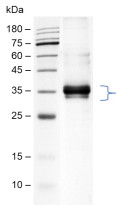
ARG70708 Human CD85k / ILT3 recombinant protein (Active) (His-tagged, C-ter) SDS-PAGE image
SDS-PAGE analysis of ARG70708 Human CD85k / ILT3 recombinant protein (Active) (His-tagged, C-ter).