ARG70844
Human CILP recombinant protein (His-tagged, C-ter)
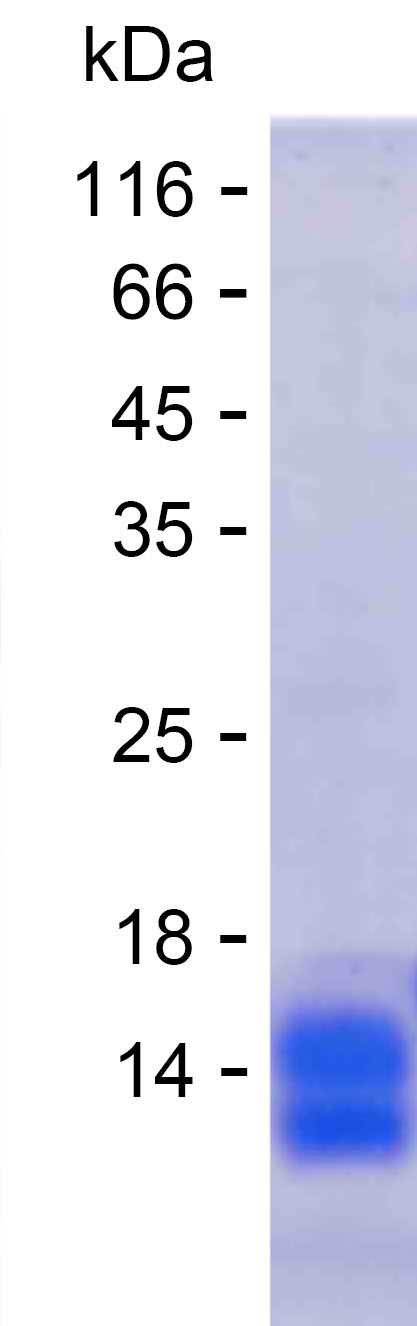
Human CILP recombinant protein (His-tagged, C-ter) for SDS-PAGE
Overview
| Product Description | E. coli expressed, His-tagged (C-ter) CILP recombinant protein |
|---|---|
| Tested Application | SDS-PAGE |
| Target Name | CILP |
| Species | Human |
| A.A. Sequence | Asn631 - Glu710 |
| Expression System | E. coli |
| Alternate Names | Cartilage intermediate layer protein 1; Cartilage intermediate-layer protein; CILP-1; HsT18872 |
Properties
| Form | Powder |
|---|---|
| Buffer | PBS |
| Reconstitution | It is recommended to reconstitute the lyophilized protein in sterile water to a concentration approximately 1 mg/mL and incubate the stock solution for at least 20 min at room temperature to make sure the protein is dissolved completely. |
| Storage Instruction | For long term, lyophilized protein should be stored at -20°C or -80°C, protected from light and moisture, for up to 12 months. After reconstitution , aliquot and store at 2 to 8°C for up to 2 days, or at -20°C or -80°C for up to 3 months Storage in frost free freezers is not recommended. Avoid repeated freeze/thaw cycles. Suggest spin the vial prior to opening. |
Bioinformation
| Gene Symbol | CILP |
|---|---|
| Gene Full Name | Cartilage intermediate layer protein |
| Background | Major alterations in the composition of the cartilage extracellular matrix occur in joint disease, such as osteoarthrosis. This gene encodes the cartilage intermediate layer protein (CILP), which increases in early osteoarthrosis cartilage. The encoded protein was thought to encode a protein precursor for two different proteins; an N-terminal CILP and a C-terminal homolog of NTPPHase, however, later studies identified no nucleotide pyrophosphatase phosphodiesterase (NPP) activity. The full-length and the N-terminal domain of this protein was shown to function as an IGF-1 antagonist. An allelic variant of this gene has been associated with lumbar disc disease. [provided by RefSeq, Sep 2010] |
| PTM | Cleaved into 2 chains possibly by a furin-like protease upon or preceding secretion. |
Images (1) Click the Picture to Zoom In
-
ARG70844 Human CILP recombinant protein (His-tagged, C-ter) SDS-PAGE image
SDS-PAGE analysis of ARG70844 Human CILP recombinant protein (His-tagged, C-ter).