ARG70914
Human CLCN3 recombinant protein (hFc-tagged and His-tagged, C-ter)
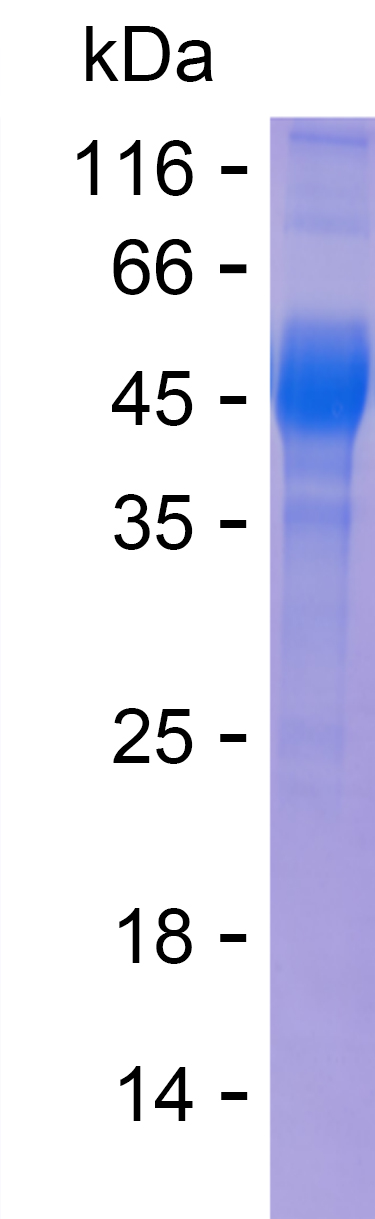
Human CLCN3 recombinant protein (hFc-tagged and His-tagged, C-ter) for SDS-PAGE
Overview
| Product Description | HEK293 expressed, Human hFc-tagged and His-tagged (C-ter) CLCN3 recombinant protein |
|---|---|
| Tested Application | SDS-PAGE |
| Target Name | CLCN3 |
| Species | Human |
| A.A. Sequence | Tyr11 - Lys120 |
| Expression System | HEK293 |
| Alternate Names | CLCN3; Chloride Voltage-Gated Channel 3; ClC-3; CLC3; Chloride Channel, Voltage-Sensitive 3; H(+)/Cl(-) Exchange Transporter 3; Chloride Channel Protein 3; Chloride Transporter ClC-3; Chloride Channel 3; NEDHYBA; NEDSBA |
Properties
| Form | Powder |
|---|---|
| Buffer | PBS |
| Reconstitution | It is recommended to reconstitute the lyophilized protein in sterile water to a concentration approximately 1 mg/mL and incubate the stock solution for at least 20 min at room temperature to make sure the protein is dissolved completely. |
| Storage Instruction | For long term, lyophilized protein should be stored at -20°C or -80°C, protected from light and moisture, for up to 12 months. After reconstitution , aliquot and store at 2 to 8°C for up to 2 days, or at -20°C or -80°C for up to 3 months Storage in frost free freezers is not recommended. Avoid repeated freeze/thaw cycles. Suggest spin the vial prior to opening. |
Bioinformation
| Gene Symbol | CLCN3 |
|---|---|
| Gene Full Name | Chloride Voltage-Gated Channel 3 |
| Background | This gene encodes a member of the voltage-gated chloride channel (ClC) family. The encoded protein is present in all cell types and localized in plasma membranes and in intracellular vesicles. It is a multi-pass membrane protein which contains a ClC domain and two additional C-terminal CBS (cystathionine beta-synthase) domains. The ClC domain catalyzes the selective flow of Cl- ions across cell membranes, and the CBS domain may have a regulatory function. This protein plays a role in both acidification and transmitter loading of GABAergic synaptic vesicles, and in smooth muscle cell activation and neointima formation. This protein is required for lysophosphatidic acid (LPA)-activated Cl- current activity and fibroblast-to-myofibroblast differentiation. The protein activity is regulated by Ca(2+)/calmodulin-dependent protein kinase II (CaMKII) in glioma cells. Multiple alternatively spliced transcript variants encoding different isoforms have been identified. [provided by RefSeq, Aug 2011] |
| Function | Isoform 1_x000D_
Strongly outwardly rectifying, electrogenic H+/Cl-exchanger which mediates the exchange of chloride ions against protons ._x000D_
The CLC channel family contains both chloride channels and proton-coupled anion transporters that exchange chloride or another anion for protons. Strongly outwardly rectifying, electrogenic H+/Cl-exchanger which mediates the exchange of chloride ions against protons. [UniProt] |
| Cellular Localization | Cell membrane; Cell projection; Endosome; Golgi apparatus; Lysosome; Membrane. [UniProt] |
| PTM | Glycoprotein. [UniProt] |
Images (1) Click the Picture to Zoom In
-
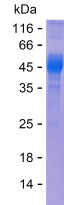
ARG70914 Human CLCN3 recombinant protein (hFc-tagged and His-tagged, C-ter) SDS-PAGE image
SDS-PAGE analysis of ARG70914 Human CLCN3 recombinant protein (hFc-tagged and His-tagged, C-ter).