ARG70835
Human Component C1s recombinant protein (His-tagged, C-ter)
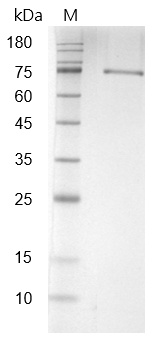
Human Component C1s recombinant protein (His-tagged, C-ter) for SDS-PAGE
Overview
| Product Description | HEK293 expressed, His-tagged (C-ter) Component C1s recombinant protein |
|---|---|
| Tested Application | SDS-PAGE |
| Target Name | Component C1s |
| Species | Human |
| A.A. Sequence | Glu16 - Asp688 |
| Expression System | HEK293 |
| Alternate Names | Complement component 1 subcomponent s; EC 3.4.21.42; Complement C1s subcomponent; C1 esterase |
Properties
| Form | Powder |
|---|---|
| Purification Note | Endotoxin level is less than 0.1 EU/µg of the protein, as determined by the LAL test. |
| Purity | > 95% (by SDS-PAGE) |
| Buffer | PBS (pH 7.4) |
| Reconstitution | It is recommended to reconstitute the lyophilized protein in sterile water to a concentration not less than 200 μg/mL and incubate the stock solution for at least 20 min at room temperature to make sure the protein is dissolved completely. |
| Storage Instruction | For long term, lyophilized protein should be stored at -20°C or -80°C. After reconstitution, aliquot and store at -20°C or -80°C for up to one month. Storage in frost free freezers is not recommended. Avoid repeated freeze/thaw cycles. Suggest spin the vial prior to opening. |
| Note | For laboratory research only, not for drug, diagnostic or other use. |
Bioinformation
| Gene Symbol | C1S |
|---|---|
| Gene Full Name | complement component 1, s subcomponent |
| Background | This gene encodes a serine protease, which is a major constituent of the human complement subcomponent C1. C1s associates with two other complement components C1r and C1q in order to yield the first component of the serum complement system. Defects in this gene are the cause of selective C1s deficiency. [provided by RefSeq, Mar 2009] |
| Function | C1s B chain is a serine protease that combines with C1q and C1r to form C1, the first component of the classical pathway of the complement system. C1r activates C1s so that it can, in turn, activate C2 and C4. [UniProt] |
| PTM | The iron and 2-oxoglutarate dependent 3-hydroxylation of aspartate and asparagine is (R) stereospecific within EGF domains. [UniProt] |
Images (1) Click the Picture to Zoom In
-

ARG70835 Human Component C1s recombinant protein (His-tagged, C-ter) SDS-PAGE image
SDS-PAGE analysis of ARG70835 Human Component C1s recombinant protein (His-tagged, C-ter).