ARG70709
Human ERBB3 / HER3 recombinant protein (Active) (His-tagged, C-ter)
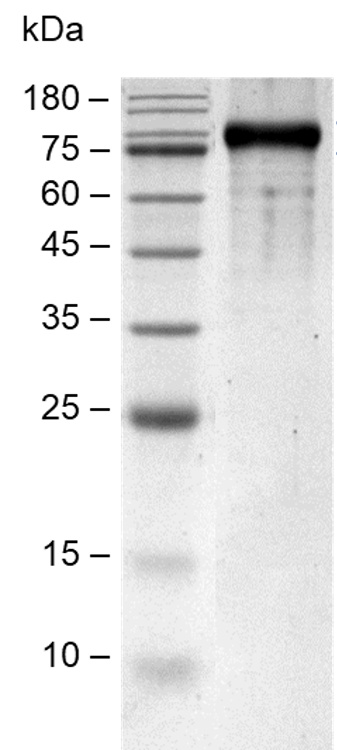
Human ERBB3 / HER3 recombinant protein (Active) (His-tagged, C-ter) for SDS-PAGE
Overview
| Product Description | CHO expressed, His-tagged (C-ter) Active ERBB3 / HER3 recombinant protein |
|---|---|
| Tested Application | SDS-PAGE |
| Target Name | ERBB3 / HER3 |
| Species | Human |
| A.A. Sequence | Ser20 - Thr643 |
| Expression System | CHO |
| Activity | Active |
| Activity Note | Determinedd by its ability to bind human NRG1 in functional ELISA. Immobilized Recombinant human NRG1 Protein at 2 μg/mL (50 μL/well) can bind Recombinant Human Her3 Protein. |
| Alternate Names | MDA-BF-1; LCCS2; p180-ErbB3; Proto-oncogene-like protein c-ErbB-3; c-erbB3; p85-sErbB3; Tyrosine kinase-type cell surface receptor HER3; p45-sErbB3; erbB3-S; HER3; c-erbB-3; ErbB-3; EC 2.7.10.1; Receptor tyrosine-protein kinase erbB-3 |
Properties
| Form | Powder |
|---|---|
| Purification Note | Endotoxin level is less than 0.1 EU/µg of the protein, as determined by the LAL test. |
| Purity | > 95% (by SDS-PAGE) |
| Buffer | PBS (pH 7.4) |
| Reconstitution | It is recommended to reconstitute the lyophilized protein in sterile water to a concentration not less than 200 μg/mL and incubate the stock solution for at least 20 min at room temperature to make sure the protein is dissolved completely. |
| Storage Instruction | For long term, lyophilized protein should be stored at -20°C or -80°C. After reconstitution, aliquot and store at -20°C or -80°C for up to one month. Storage in frost free freezers is not recommended. Avoid repeated freeze/thaw cycles. Suggest spin the vial prior to opening. |
| Note | For laboratory research only, not for drug, diagnostic or other use. |
Bioinformation
| Gene Symbol | ERBB3 |
|---|---|
| Gene Full Name | erb-b2 receptor tyrosine kinase 3 |
| Background | This gene encodes a member of the epidermal growth factor receptor (EGFR) family of receptor tyrosine kinases. This membrane-bound protein has a neuregulin binding domain but not an active kinase domain. It therefore can bind this ligand but not convey the signal into the cell through protein phosphorylation. However, it does form heterodimers with other EGF receptor family members which do have kinase activity. Heterodimerization leads to the activation of pathways which lead to cell proliferation or differentiation. Amplification of this gene and/or overexpression of its protein have been reported in numerous cancers, including prostate, bladder, and breast tumors. Alternate transcriptional splice variants encoding different isoforms have been characterized. One isoform lacks the intermembrane region and is secreted outside the cell. This form acts to modulate the activity of the membrane-bound form. Additional splice variants have also been reported, but they have not been thoroughly characterized. [provided by RefSeq, Jul 2008] |
| Function | Binds and is activated by neuregulins and NTAK. May also be activated by CSPG5. [UniProt] |
| PTM | Autophosphorylated (PubMed:20351256). Ligand-binding increases phosphorylation on tyrosine residues and promotes its association with the p85 subunit of phosphatidylinositol 3-kinase (PubMed:20682778). |
Images (1) Click the Picture to Zoom In
-
ARG70709 Human ERBB3 / HER3 recombinant protein (Active) (His-tagged, C-ter) SDS-PAGE image
SDS-PAGE analysis of ARG70709 Human ERBB3 / HER3 recombinant protein (Active) (His-tagged, C-ter).