ARG70673
Human EpCAM recombinant protein (Active) (His-tagged, C-ter)
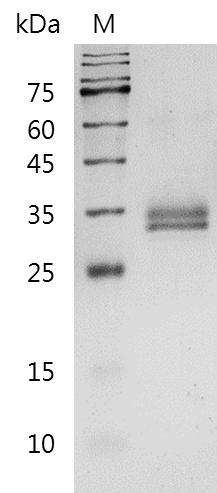
Human EpCAM recombinant protein (Active) (His-tagged, C-ter) for SDS-PAGE
Overview
| Product Description | HEK293 expressed, His-tagged (C-ter) Active EpCAM recombinant protein |
|---|---|
| Tested Application | SDS-PAGE |
| Target Name | EpCAM |
| Species | Human |
| A.A. Sequence | Gln24 - Lys265 |
| Expression System | HEK293 |
| Activity | Active |
| Activity Note | Determinedd by the ability of the immobilized protein to support the adhesion of NIH-3T3 mouse embryonic fibroblast cells.The ED₅₀ for this effect is 0.4-3 μg/mL. |
| Alternate Names | MIC18; EGP; Tumor-associated calcium signal transducer 1; Epithelial glycoprotein 314; KSA; Ep-CAM; Epithelial cell surface antigen; Adenocarcinoma-associated antigen; HNPCC8; Cell surface glycoprotein Trop-1; EGP40; TACSTD1; KS1/4; hEGP314; Major gastrointestinal tumor-associated protein GA733-2; M4S1; MK-1; Epithelial glycoprotein; KS 1/4 antigen; ESA; DIAR5; EGP314; Epithelial cell adhesion molecule; EGP-2; TROP1; CD antigen CD326 |
Properties
| Form | Powder |
|---|---|
| Purification Note | Endotoxin level is less than 0.1 EU/µg of the protein, as determined by the LAL test. |
| Purity | > 95% (by SDS-PAGE) |
| Buffer | PBS (pH 7.4) |
| Reconstitution | It is recommended to reconstitute the lyophilized protein in sterile water to a concentration not less than 200 μg/mL and incubate the stock solution for at least 20 min at room temperature to make sure the protein is dissolved completely. |
| Storage Instruction | For long term, lyophilized protein should be stored at -20°C or -80°C. After reconstitution, aliquot and store at -20°C or -80°C for up to one month. Storage in frost free freezers is not recommended. Avoid repeated freeze/thaw cycles. Suggest spin the vial prior to opening. |
| Note | For laboratory research only, not for drug, diagnostic or other use. |
Bioinformation
| Gene Symbol | EPCAM |
|---|---|
| Gene Full Name | epithelial cell adhesion molecule |
| Background | EpCAM is a carcinoma-associated antigen and is a member of a family that includes at least two type I membrane proteins. This antigen is expressed on most normal epithelial cells and gastrointestinal carcinomas and functions as a homotypic calcium-independent cell adhesion molecule. The antigen is being used as a target for immunotherapy treatment of human carcinomas. Mutations in this gene result in congenital tufting enteropathy. [provided by RefSeq, Dec 2008] |
| Function | EpCAM may act as a physical homophilic interaction molecule between intestinal epithelial cells (IECs) and intraepithelial lymphocytes (IELs) at the mucosal epithelium for providing immunological barrier as a first line of defense against mucosal infection. Plays a role in embryonic stem cells proliferation and differentiation. Up-regulates the expression of FABP5, MYC and cyclins A and E. [UniProt] |
| PTM | Hyperglycosylated in carcinoma tissue as compared with autologous normal epithelia. Glycosylation at Asn-198 is crucial for protein stability. |
Images (1) Click the Picture to Zoom In
-
ARG70673 Human EpCAM recombinant protein (Active) (His-tagged, C-ter) SDS-PAGE image
SDS-PAGE analysis of ARG70673 Human EpCAM recombinant protein (Active) (His-tagged, C-ter).