ARG70897
Human EphB6 recombinant protein (His-tagged, C-ter)
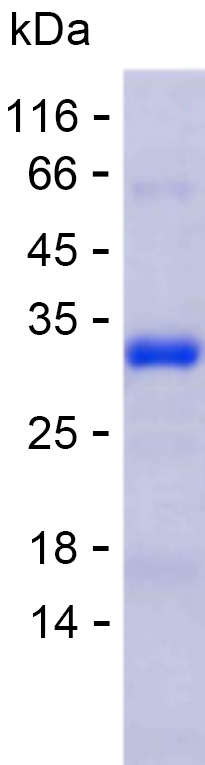
Human EphB6 recombinant protein (His-tagged, C-ter) for SDS-PAGE
Overview
| Product Description | E. coli expressed, His-tagged (C-ter) EphB6 recombinant protein |
|---|---|
| Tested Application | SDS-PAGE |
| Target Name | EphB6 |
| Species | Human |
| A.A. Sequence | Ser371 - Leu580 |
| Expression System | E. coli |
| Alternate Names | Tyrosine-protein kinase-defective receptor EPH-6; HEP; Ephrin type-B receptor 6 |
Properties
| Form | Powder |
|---|---|
| Buffer | PBS |
| Reconstitution | It is recommended to reconstitute the lyophilized protein in sterile water to a concentration approximately 1 mg/mL and incubate the stock solution for at least 20 min at room temperature to make sure the protein is dissolved completely. |
| Storage Instruction | For long term, lyophilized protein should be stored at -20°C or -80°C, protected from light and moisture, for up to 12 months. After reconstitution , aliquot and store at 2 to 8°C for up to 2 days, or at -20°C or -80°C for up to 3 months Storage in frost free freezers is not recommended. Avoid repeated freeze/thaw cycles. Suggest spin the vial prior to opening. |
Bioinformation
| Gene Symbol | EPHB6 |
|---|---|
| Gene Full Name | EPH receptor B6 |
| Background | This gene encodes a member of a family of transmembrane proteins that function as receptors for ephrin-B family proteins. Unlike other members of this family, the encoded protein does not contain a functional kinase domain. Activity of this protein can influence cell adhesion and migration. Expression of this gene is downregulated during tumor progression, suggesting that the protein may suppress tumor invasion and metastasis. Alternative splicing results in multiple transcript variants. [provided by RefSeq, Jul 2013] |
| Function | Kinase-defective receptor for members of the ephrin-B family. Binds to ephrin-B1 and ephrin-B2. Modulates cell adhesion and migration by exerting both positive and negative effects upon stimulation with ephrin-B2. Inhibits JNK activation, T-cell receptor-induced IL-2 secretion and CD25 expression upon stimulation with ephrin-B2. [UniProt] |
| Cellular Localization | Membrane, Secreted, Single-pass type I membrane protein. [UniProt] |
| PTM | Ligand-binding increases phosphorylation on tyrosine residues. Phosphorylation on tyrosine residues is mediated by transphosphorylation by the catalytically active EPHB1 in a ligand-independent manner. Tyrosine phosphorylation of the receptor may act as a switch on the functional transition from cell adhesion/attraction to de-adhesion/repulsion. [UniProt] |
Images (1) Click the Picture to Zoom In
-
ARG70897 Human EphB6 recombinant protein (His-tagged, C-ter) SDS-PAGE image
SDS-PAGE analysis of ARG70897 Human EphB6 recombinant protein (His-tagged, C-ter).