ARG70929
Human IFIH1 / MDA5 recombinant protein (His-tagged, C-ter)
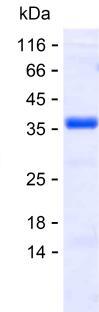
Human IFIH1 / MDA5 recombinant protein (His-tagged, C-ter) for SDS-PAGE
Overview
| Product Description | E. coli expressed, His-tagged (C-ter) IFIH1 / MDA5 recombinant protein |
|---|---|
| Tested Application | SDS-PAGE |
| Target Name | IFIH1 / MDA5 |
| Species | Human |
| A.A. Sequence | Gln531 - Arg820 |
| Expression System | E. coli |
| Alternate Names | Interferon-induced helicase C domain-containing protein 1; Murabutide down-regulated protein; SGMRT1; EC 3.6.4.13; RIG-I-like receptor 2; MDA5; Clinically amyopathic dermatomyositis autoantigen 140 kDa; AGS7; MDA-5; CADM-140 autoantigen; Melanoma differentiation-associated protein 5; IDDM19; Interferon-induced with helicase C domain protein 1; RNA helicase-DEAD box protein 116; Helicard; RLR-2; Hlcd; Helicase with 2 CARD domains |
Properties
| Form | Powder |
|---|---|
| Buffer | PBS |
| Reconstitution | It is recommended to reconstitute the lyophilized protein in sterile water to a concentration approximately 1 mg/mL and incubate the stock solution for at least 20 min at room temperature to make sure the protein is dissolved completely. |
| Storage Instruction | For long term, lyophilized protein should be stored at -20°C or -80°C, protected from light and moisture, for up to 12 months. After reconstitution , aliquot and store at 2 to 8°C for up to 2 days, or at -20°C or -80°C for up to 3 months Storage in frost free freezers is not recommended. Avoid repeated freeze/thaw cycles. Suggest spin the vial prior to opening. |
Bioinformation
| Gene Symbol | IFIH1 |
|---|---|
| Gene Full Name | interferon induced with helicase C domain 1 |
| Background | DEAD box proteins, characterized by the conserved motif Asp-Glu-Ala-Asp (DEAD), are putative RNA helicases. They are implicated in a number of cellular processes involving alteration of RNA secondary structure such as translation initiation, nuclear and mitochondrial splicing, and ribosome and spliceosome assembly. Based on their distribution patterns, some members of this family are believed to be involved in embryogenesis, spermatogenesis, and cellular growth and division. This gene encodes a DEAD box protein that is upregulated in response to treatment with beta-interferon and a protein kinase C-activating compound, mezerein. Irreversible reprogramming of melanomas can be achieved by treatment with both these agents; treatment with either agent alone only achieves reversible differentiation. Genetic variation in this gene is associated with diabetes mellitus insulin-dependent type 19. [provided by RefSeq, Jul 2012] |
| Function | Innate immune receptor which acts as a cytoplasmic sensor of viral nucleic acids and plays a major role in sensing viral infection and in the activation of a cascade of antiviral responses including the induction of type I interferons and proinflammatory cytokines. Its ligands include mRNA lacking 2'-O-methylation at their 5' cap and long-dsRNA (>1 kb in length). Upon ligand binding it associates with mitochondria antiviral signaling protein (MAVS/IPS1) which activates the IKK-related kinases: TBK1 and IKBKE which phosphorylate interferon regulatory factors: IRF3 and IRF7 which in turn activate transcription of antiviral immunological genes, including interferons (IFNs); IFN-alpha and IFN-beta. Responsible for detecting the Picornaviridae family members such as encephalomyocarditis virus (EMCV) and mengo encephalomyocarditis virus (ENMG). Can also detect other viruses such as dengue virus (DENV), west Nile virus (WNV), and reovirus. Also involved in antiviral signaling in response to viruses containing a dsDNA genome, such as vaccinia virus. Plays an important role in amplifying innate immune signaling through recognition of RNA metabolites that are produced during virus infection by ribonuclease L (RNase L). May play an important role in enhancing natural killer cell function and may be involved in growth inhibition and apoptosis in several tumor cell lines. [UniProt] |
| Cellular Localization | Cytoplasm. Nucleus. Note=May be found in the nucleus, during apoptosis. [UniProt] |
| PTM | Sumoylated. Sumoylation positively regulates its role in type I interferon induction and is enhanced by PIAS2-beta. Ubiquitinated by RNF125, leading to its degradation by the proteasome (PubMed:17460044). USP17/UPS17L2-dependent deubiquitination positively regulates the receptor (PubMed:20368735). During apoptosis, processed into 3 cleavage products. The helicase-containing fragment, once liberated from the CARD domains, translocate from the cytoplasm to the nucleus. The processed protein significantly sensitizes cells to DNA degradation. [UniProt] |
Images (1) Click the Picture to Zoom In
-
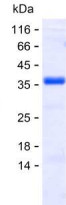
ARG70929 Human IFIH1 / MDA5 recombinant protein (His-tagged, C-ter) SDS-PAGE image
SDS-PAGE analysis of ARG70929 Human IFIH1 / MDA5 recombinant protein (His-tagged, C-ter).