ARG70707
Human IFNAR1 recombinant protein (His-tagged, C-ter)
Human IFNAR1 recombinant protein (His-tagged, C-ter) for SDS-PAGE
Overview
| Product Description | CHO expressed, His-tagged (C-ter) IFNAR1 recombinant protein |
|---|---|
| Tested Application | SDS-PAGE |
| Target Name | IFNAR1 |
| Species | Human |
| A.A. Sequence | Lys 28 - Lys 436 |
| Expression System | CHO |
| Alternate Names | Cytokine receptor class-II member 1; Cytokine receptor family 2 member 1; IFRC; IFNAR; AVP; IFN-alpha/beta receptor 1; CRF2-1; IFN-R-1; Type I interferon receptor 1; IFNBR; Interferon alpha/beta receptor 1; IFN-alpha-REC |
Properties
| Form | Powder |
|---|---|
| Purification Note | Endotoxin level is less than 0.1 EU/µg of the protein, as determined by the LAL test. |
| Purity | > 95% (by SDS-PAGE) |
| Buffer | PBS (pH 7.4) |
| Reconstitution | It is recommended to reconstitute the lyophilized protein in sterile water to a concentration not less than 200 μg/mL and incubate the stock solution for at least 20 min at room temperature to make sure the protein is dissolved completely. |
| Storage Instruction | For long term, lyophilized protein should be stored at -20°C or -80°C. After reconstitution, aliquot and store at -20°C or -80°C for up to one month. Storage in frost free freezers is not recommended. Avoid repeated freeze/thaw cycles. Suggest spin the vial prior to opening. |
| Note | For laboratory research only, not for drug, diagnostic or other use. |
Bioinformation
| Gene Symbol | IFNAR1 |
|---|---|
| Gene Full Name | interferon (alpha, beta and omega) receptor 1 |
| Background | The protein encoded by this gene is a type I membrane protein that forms one of the two chains of a receptor for interferons alpha and beta. Binding and activation of the receptor stimulates Janus protein kinases, which in turn phosphorylate several proteins, including STAT1 and STAT2. The encoded protein also functions as an antiviral factor. [provided by RefSeq, Jul 2008] |
| Function | Associates with IFNAR2 to form the type I interferon receptor. Receptor for interferons alpha and beta. Binding to type I IFNs triggers tyrosine phosphorylation of a number of proteins including JAKs, TYK2, STAT proteins and IFNR alpha- and beta-subunits themselves. Can also transduce IFNB signals without the help of IFNAR2, and not activating the Jak-STAT pathway. [UniProt] |
| Cellular Localization | Isoform 1: Cell membrane; Single-pass type I membrane protein. Late endosome. Lysosome. Note=Interferon binding triggers internalization of the receptor from the cell membrane into endosomes and then into lysosomes. [UniProt] |
| PTM | Ubiquitinated, leading to its internalization and degradation (PubMed:14532120, PubMed:15337770). Polyubiquitinated via 'Lys-48'-linked and 'Lys-63'-linked ubiquitin chains, leading to receptor internalization and lysosomal degradation (PubMed:18056411). The 'Lys-63'-linked ubiquitin chains are cleaved off by the BRISC complex (PubMed:24075985). Phosphorylated on serine residues in response to interferon binding; this promotes interaction with FBXW11 and ubiquitination (PubMed:14532120, PubMed:15337770, PubMed:24075985). Phosphorylated on tyrosine residues by TYK2 tyrosine kinase (PubMed:7526154). Phosphorylated on tyrosine residues in response to interferon (PubMed:10049744). Palmitoylation at Cys-463 is required for the activation of STAT1 and STAT2. [UniProt] |
Images (1) Click the Picture to Zoom In
-

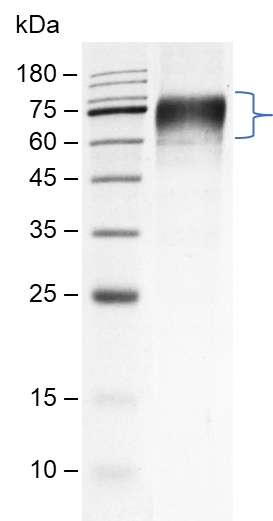
ARG70707 Human IFNAR1 recombinant protein (His-tagged, C-ter) SDS-PAGE image
SDS-PAGE analysis of ARG70707 Human IFNAR1 recombinant protein (His-tagged, C-ter).