ARG70850
Human IL16 (aa 2-130) recombinant protein (His-tagged, C-ter)
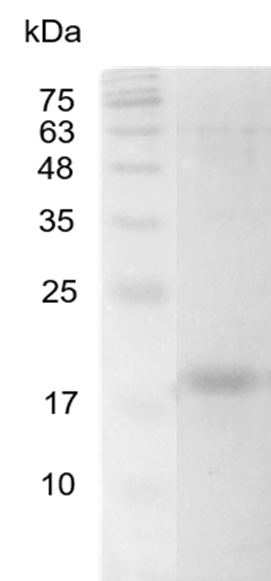
Human IL16 (aa 2-130) recombinant protein (His-tagged, C-ter) for SDS-PAGE
Overview
| Product Description | E. coli expressed, His-tagged (C-ter) IL16 (aa 2-130) recombinant protein |
|---|---|
| Tested Application | SDS-PAGE |
| Target Name | IL16 (aa 2-130) |
| Species | Human |
| A.A. Sequence | Met1203 - Ser1332 |
| Expression System | E. coli |
| Alternate Names | prIL-16; Lymphocyte chemoattractant factor; PRIL16; IL-16; NIL16; LCF; Pro-interleukin-16 |
Properties
| Form | Powder |
|---|---|
| Purification Note | Endotoxin level is less than 0.1 EU per 1 μg of the protein by the LAL method. |
| Purity | > 95% (by SDS-PAGE) |
| Buffer | PBS (pH 8.0) |
| Reconstitution | It is recommended to reconstitute the lyophilized protein in sterile water to a concentration not less than 200 μg/mL and incubate the stock solution for at least 20 min at room temperature to make sure the protein is dissolved completely. |
| Storage Instruction | For long term, lyophilized protein should be stored at -20°C or -80°C. After reconstitution, aliquot and store at -20°C or -80°C for up to one month. Storage in frost free freezers is not recommended. Avoid repeated freeze/thaw cycles. Suggest spin the vial prior to opening. |
| Note | For laboratory research only, not for drug, diagnostic or other use. |
Bioinformation
| Gene Symbol | IL16 |
|---|---|
| Gene Full Name | interleukin 16 |
| Background | Interleukin 16 (IL-16) is a pleiotropic cytokine, possessing immunomodulation function to allergic inflammatory diseases such as Crohn's disease and ulcerative colitis. IL-16 utilizes CD4 as its primary receptor. IL-16 is a chemo-attractant to CD4+ T helper 1 cells. To CD4+ T helper 2 cells, IL-16 has an inhibitory effect on the antigen-mediated CD3/T cell receptor activation. IL-16 has been shown to suppress HIV infection in lymphocytes and monocytes. |
| Function | Interleukin-16 stimulates a migratory response in CD4+ lymphocytes, monocytes, and eosinophils. Primes CD4+ T-cells for IL-2 and IL-15 responsiveness. Also induces T-lymphocyte expression of interleukin 2 receptor. Ligand for CD4. Isoform 1 may act as a scaffolding protein that anchors ion channels in the membrane. Isoform 3 is involved in cell cycle progression in T-cells. Appears to be involved in transcriptional regulation of SKP2 and is probably part of a transcriptional repression complex on the core promoter of the SKP2 gene. May act as a scaffold for GABPB1 (the DNA-binding subunit the GABP transcription factor complex) and HDAC3 thus maintaining transcriptional repression and blocking cell cycle progression in resting T-cells. [UniProt] |
Images (1) Click the Picture to Zoom In
-
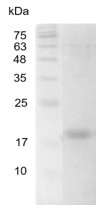
ARG70850 Human IL16 (aa 2-130) recombinant protein (His-tagged, C-ter) SDS-PAGE image
SDS-PAGE analysis of ARG70850 Human IL16 (aa 2-130) recombinant protein (His-tagged, C-ter).