ARG70942
Human Ku 70 recombinant protein (His-tagged, C-ter)
Human Ku 70 recombinant protein (His-tagged, C-ter) for SDS-PAGE
Overview
| Product Description | E. coli expressed, His-tagged (C-ter) Ku 70 recombinant protein |
|---|---|
| Tested Application | SDS-PAGE |
| Target Name | Ku 70 |
| Species | Human |
| A.A. Sequence | Glu11 - Glu240 |
| Expression System | E. coli |
| Alternate Names | DNA repair protein XRCC6; Thyroid-lupus autoantigen; Lupus Ku autoantigen protein p70; EC 4.2.99.-; EC 3.6.4.-; ATP-dependent DNA helicase II 70 kDa subunit; X-ray repair complementing defective repair in Chinese hamster cells 6; CTC box-binding factor 75 kDa subunit; 70 kDa subunit of Ku antigen; CTC75; 5'-deoxyribose-5-phosphate lyase Ku70; KU70; TLAA; 5'-dRP lyase Ku70; CTCBF; ML8; G22P1; X-ray repair cross-complementing protein 6; ATP-dependent DNA helicase 2 subunit 1; Ku70 |
Properties
| Form | Powder |
|---|---|
| Buffer | PBS |
| Reconstitution | It is recommended to reconstitute the lyophilized protein in sterile water to a concentration approximately 1 mg/mL and incubate the stock solution for at least 20 min at room temperature to make sure the protein is dissolved completely. |
| Storage Instruction | For long term, lyophilized protein should be stored at -20°C or -80°C, protected from light and moisture, for up to 12 months. After reconstitution , aliquot and store at 2 to 8°C for up to 2 days, or at -20°C or -80°C for up to 3 months Storage in frost free freezers is not recommended. Avoid repeated freeze/thaw cycles. Suggest spin the vial prior to opening. |
Bioinformation
| Gene Symbol | XRCC6 |
|---|---|
| Gene Full Name | X-ray repair complementing defective repair in Chinese hamster cells 6 |
| Background | The p70/p80 autoantigen is a nuclear complex consisting of two subunits with molecular masses of approximately 70 and 80 kDa. The complex functions as a single-stranded DNA-dependent ATP-dependent helicase. The complex may be involved in the repair of nonhomologous DNA ends such as that required for double-strand break repair, transposition, and V(D)J recombination. High levels of autoantibodies to p70 and p80 have been found in some patients with systemic lupus erythematosus. [provided by RefSeq, Jul 2008] |
| Function | Single-stranded DNA-dependent ATP-dependent helicase. Has a role in chromosome translocation. The DNA helicase II complex binds preferentially to fork-like ends of double-stranded DNA in a cell cycle-dependent manner. It works in the 3'-5' direction. Binding to DNA may be mediated by XRCC6. Involved in DNA non-homologous end joining (NHEJ) required for double-strand break repair and V(D)J recombination. The XRCC5/6 dimer acts as regulatory subunit of the DNA-dependent protein kinase complex DNA-PK by increasing the affinity of the catalytic subunit PRKDC to DNA by 100-fold. The XRCC5/6 dimer is probably involved in stabilizing broken DNA ends and bringing them together. The assembly of the DNA-PK complex to DNA ends is required for the NHEJ ligation step. Required for osteocalcin gene expression. Probably also acts as a 5'-deoxyribose-5-phosphate lyase (5'-dRP lyase), by catalyzing the beta-elimination of the 5' deoxyribose-5-phosphate at an abasic site near double-strand breaks. 5'-dRP lyase activity allows to 'clean' the termini of abasic sites, a class of nucleotide damage commonly associated with strand breaks, before such broken ends can be joined. The XRCC5/6 dimer together with APEX1 acts as a negative regulator of transcription. Plays a role in the regulation of DNA virus-mediated innate immune response by assembling into the HDP-RNP complex, a complex that serves as a platform for IRF3 phosphorylation and subsequent innate immune response activation through the cGAS-STING pathway. [UniProt] |
| Cellular Localization | Nucleus. Chromosome. [UniProt] |
| PTM | Phosphorylation by PRKDC may enhance helicase activity. Phosphorylation of Ser-51 does not affect DNA repair. [UniProt] |
Images (1) Click the Picture to Zoom In
-

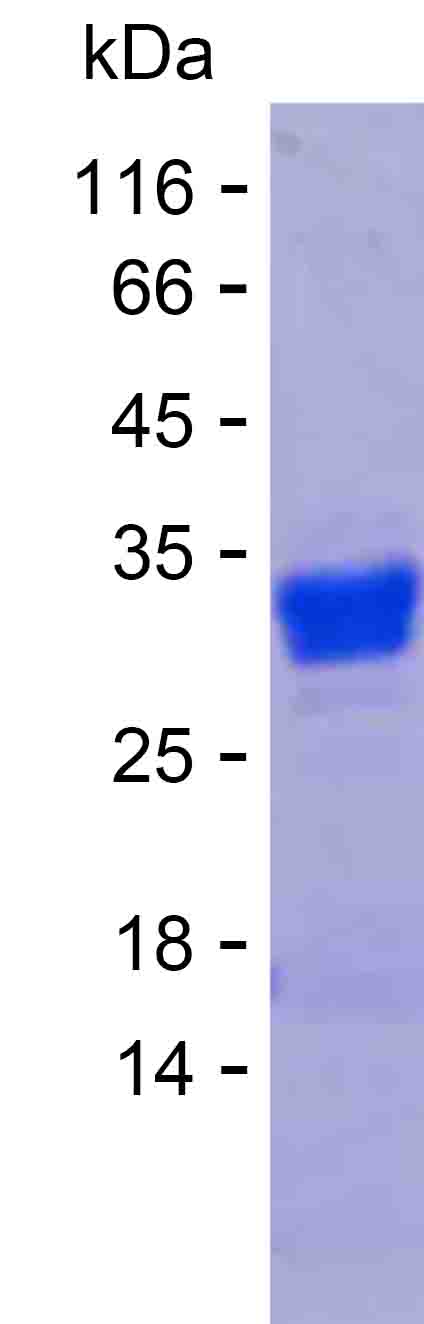
ARG70942 Human Ku 70 recombinant protein (His-tagged, C-ter) SDS-PAGE image
SDS-PAGE analysis of ARG70942 Human Ku 70 recombinant protein (His-tagged, C-ter).