ARG70821
Human L1CAM recombinant protein (Active) (His-tagged, C-ter)
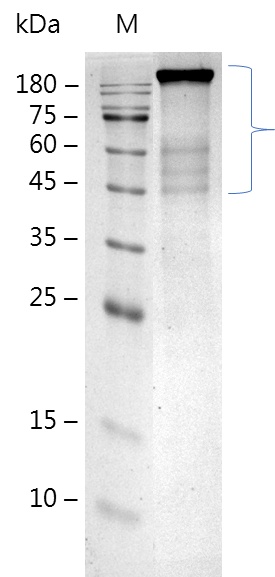
Human L1CAM recombinant protein (Active) (His-tagged, C-ter) for SDS-PAGE
Overview
| Product Description | CHO expressed, His-tagged (C-ter) Active L1CAM recombinant protein |
|---|---|
| Tested Application | SDS-PAGE |
| Target Name | L1CAM |
| Species | Human |
| A.A. Sequence | Ile 20 - Glu 1120 |
| Expression System | CHO |
| Activity | Active |
| Activity Note | Determinedd by its ability to support the adhesion of SH-SY5Y human neuroblastoma cells when immobilized, with the ED50 being less than 15 μg/mL. |
| Alternate Names | SPG1; CD171; NCAM-L1; MASA; MIC5; S10; CAML1; HSAS1; N-CAM-L1; CD antigen CD171; N-CAML1; HSAS; Neural cell adhesion molecule L1 |
Properties
| Form | Powder |
|---|---|
| Purification Note | Endotoxin level is less than 0.1 EU/µg of the protein, as determined by the LAL test. |
| Purity | > 95% (by SDS-PAGE) |
| Buffer | PBS (pH 7.4) |
| Reconstitution | It is recommended to reconstitute the lyophilized protein in sterile water to a concentration not less than 200 μg/mL and incubate the stock solution for at least 20 min at room temperature to make sure the protein is dissolved completely. |
| Storage Instruction | For long term, lyophilized protein should be stored at -20°C or -80°C. After reconstitution, aliquot and store at -20°C or -80°C for up to one month. Storage in frost free freezers is not recommended. Avoid repeated freeze/thaw cycles. Suggest spin the vial prior to opening. |
| Note | For laboratory research only, not for drug, diagnostic or other use. |
Bioinformation
| Gene Symbol | L1CAM |
|---|---|
| Gene Full Name | L1 cell adhesion molecule |
| Background | The protein encoded by this gene is an axonal glycoprotein belonging to the immunoglobulin supergene family. The ectodomain, consisting of several immunoglobulin-like domains and fibronectin-like repeats (type III), is linked via a single transmembrane sequence to a conserved cytoplasmic domain. This cell adhesion molecule plays an important role in nervous system development, including neuronal migration and differentiation. Mutations in the gene cause X-linked neurological syndromes known as CRASH (corpus callosum hypoplasia, retardation, aphasia, spastic paraplegia and hydrocephalus). Alternative splicing of this gene results in multiple transcript variants, some of which include an alternate exon that is considered to be specific to neurons. [provided by RefSeq, May 2013] |
| Function | Cell adhesion molecule with an important role in the development of the nervous system. Involved in neuron-neuron adhesion, neurite fasciculation, outgrowth of neurites, etc. Binds to axonin on neurons. [UniProt] |
| Cellular Localization | Cell membrane; Single-pass type I membrane protein. Cell projection, growth cone. Cell projection, axon. Cell projection, dendrite. Note=Colocalized with SHTN1 in close apposition with actin filaments in filopodia and lamellipodia of axonalne growth cones of hippocampal neurons (By similarity). In neurons, detected predominantly in axons and cell body, weak localization to dendrites (PubMed:20621658). [UniProt] |
Images (1) Click the Picture to Zoom In
-
ARG70821 Human L1CAM recombinant protein (Active) (His-tagged, C-ter) SDS-PAGE image
SDS-PAGE analysis of ARG70821 Human L1CAM recombinant protein (Active) (His-tagged, C-ter).