ARG70717
Human LALBA / Lactalbumin recombinant protein (His-tagged, C-ter)
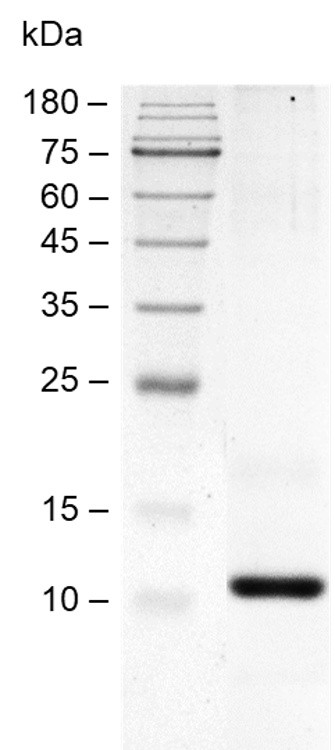
Human LALBA / Lactalbumin recombinant protein (His-tagged, C-ter) for SDS-PAGE
Overview
| Product Description | CHO expressed, His-tagged (C-ter) LALBA / Lactalbumin recombinant protein |
|---|---|
| Tested Application | SDS-PAGE |
| Target Name | LALBA / Lactalbumin |
| Species | Human |
| A.A. Sequence | Lys20 - Leu142 |
| Expression System | CHO |
| Alternate Names | Lactose synthase B protein; Alpha-lactalbumin; Lysozyme-like protein 7 |
Properties
| Form | Powder |
|---|---|
| Purification Note | Endotoxin level is less than 0.1 EU/µg of the protein, as determined by the LAL test. |
| Purity | > 95% (by SDS-PAGE) |
| Buffer | PBS (pH 7.4) |
| Reconstitution | It is recommended to reconstitute the lyophilized protein in sterile water to a concentration not less than 200 μg/mL and incubate the stock solution for at least 20 min at room temperature to make sure the protein is dissolved completely. |
| Storage Instruction | For long term, lyophilized protein should be stored at -20°C or -80°C. After reconstitution, aliquot and store at -20°C or -80°C for up to one month. Storage in frost free freezers is not recommended. Avoid repeated freeze/thaw cycles. Suggest spin the vial prior to opening. |
| Note | For laboratory research only, not for drug, diagnostic or other use. |
Bioinformation
| Gene Symbol | LALBA |
|---|---|
| Gene Full Name | lactalbumin, alpha- |
| Background | This gene encodes alpha-lactalbumin, a principal protein of milk. Alpha-lactalbumin forms the regulatory subunit of the lactose synthase (LS) heterodimer and beta 1,4-galactosyltransferase (beta4Gal-T1) forms the catalytic component. Together, these proteins enable LS to produce lactose by transfering galactose moieties to glucose. As a monomer, alpha-lactalbumin strongly binds calcium and zinc ions and may possess bactericidal or antitumor activity. A folding variant of alpha-lactalbumin, called HAMLET, likely induces apoptosis in tumor and immature cells. [provided by RefSeq, Jul 2008] |
| Function | Regulatory subunit of lactose synthase, changes the substrate specificity of galactosyltransferase in the mammary gland making glucose a good acceptor substrate for this enzyme. This enables LS to synthesize lactose, the major carbohydrate component of milk. In other tissues, galactosyltransferase transfers galactose onto the N-acetylglucosamine of the oligosaccharide chains in glycoproteins. [UniProt] |
Images (1) Click the Picture to Zoom In
-

ARG70717 Human LALBA / Lactalbumin recombinant protein (His-tagged, C-ter) SDS-PAGE image
SDS-PAGE analysis of ARG70717 Human LALBA / Lactalbumin recombinant protein (His-tagged, C-ter).