ARG70721
Human LGR5 / GPR49 recombinant protein (Active) (His-tagged, C-ter)
Human LGR5 / GPR49 recombinant protein (Active) (His-tagged, C-ter) for SDS-PAGE
Overview
| Product Description | CHO expressed, His-tagged (C-ter) Active LGR5 / GPR49 recombinant protein |
|---|---|
| Tested Application | SDS-PAGE |
| Target Name | LGR5 / GPR49 |
| Species | Human |
| A.A. Sequence | Gly 22 - Arg 561 |
| Expression System | CHO |
| Activity | Active |
| Activity Note | Determinedd by its ability to bind human RSPO1 in functional ELISA. Immobilized Recombinant human RSPO1 Protein at 5 μg/mL (100 μL/well) can bind Recombinant Human LGR5 Protein. |
| Alternate Names | Leucine-rich repeat-containing G-protein coupled receptor 5; G-protein coupled receptor 49; GRP49; G-protein coupled receptor 67; GPR67; GPR49; HG38; G-protein coupled receptor HG38; FEX |
Properties
| Form | Powder |
|---|---|
| Purification Note | Endotoxin level is less than 0.1 EU/µg of the protein, as determined by the LAL test. |
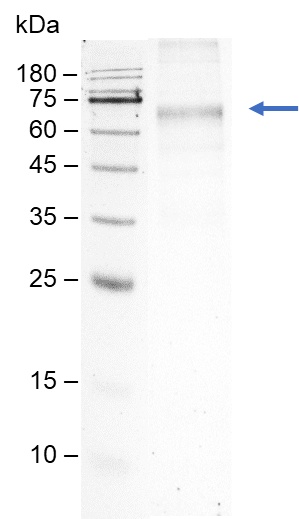
| Purity | > 80% (by SDS-PAGE) |
| Buffer | PBS (pH 7.4) |
| Reconstitution | It is recommended to reconstitute the lyophilized protein in sterile water to a concentration not less than 200 μg/mL and incubate the stock solution for at least 20 min at room temperature to make sure the protein is dissolved completely. |
| Storage Instruction | For long term, lyophilized protein should be stored at -20°C or -80°C. After reconstitution, aliquot and store at -20°C or -80°C for up to one month. Storage in frost free freezers is not recommended. Avoid repeated freeze/thaw cycles. Suggest spin the vial prior to opening. |
| Note | For laboratory research only, not for drug, diagnostic or other use. |
Bioinformation
| Gene Symbol | LGR5 |
|---|---|
| Gene Full Name | leucine-rich repeat containing G protein-coupled receptor 5 |
| Background | The protein encoded by this gene is a leucine-rich repeat-containing receptor (LGR) and member of the G protein-coupled, 7-transmembrane receptor (GPCR) superfamily. The encoded protein is a receptor for R-spondins and is involved in the canonical Wnt signaling pathway. This protein plays a role in the formation and maintenance of adult intestinal stem cells during postembryonic development. Several transcript variants encoding different isoforms have been found for this gene. [provided by RefSeq, Sep 2015] |
| Function | Receptor for R-spondins that potentiates the canonical Wnt signaling pathway and acts as a stem cell marker of the intestinal epithelium and the hair follicle. Upon binding to R-spondins (RSPO1, RSPO2, RSPO3 or RSPO4), associates with phosphorylated LRP6 and frizzled receptors that are activated by extracellular Wnt receptors, triggering the canonical Wnt signaling pathway to increase expression of target genes. In contrast to classical G-protein coupled receptors, does not activate heterotrimeric G-proteins to transduce the signal. Involved in the development and/or maintenance of the adult intestinal stem cells during postembryonic development. [UniProt] |
| Cellular Localization | Cell membrane; Multi-pass membrane protein. Golgi apparatus, trans-Golgi network membrane; Multi-pass membrane protein. Note=Rapidly and constitutively internalized to the trans-Golgi network at steady state. Internalization to the trans-Golgi network may be the result of phosphorylation at Ser-861 and Ser-864; however, the phosphorylation event has not been proven (PubMed:23439653). [UniProt] |
Images (1) Click the Picture to Zoom In
-

ARG70721 Human LGR5 / GPR49 recombinant protein (Active) (His-tagged, C-ter) SDS-PAGE image
SDS-PAGE analysis of ARG70721 Human LGR5 / GPR49 recombinant protein (Active) (His-tagged, C-ter).