ARG70898
Human MAPK13 / SAPK4 recombinant protein (His-tagged, C-ter)
Human MAPK13 / SAPK4 recombinant protein (His-tagged, C-ter) for SDS-PAGE
Overview
| Product Description | E. coli expressed, His-tagged (C-ter) MAPK13 / SAPK4 recombinant protein |
|---|---|
| Tested Application | SDS-PAGE |
| Target Name | MAPK13 / SAPK4 |
| Species | Human |
| A.A. Sequence | Lys11 - Ser350 |
| Expression System | E. coli |
| Alternate Names | MAPK13; mitogen-activated protein kinase 13; p38delta; Mitogen-activated protein kinase p38 delta; EC 2.7.11.24; PRKM13; MAP kinase 13; Stress-activated protein kinase 4; MAPK-13; SAPK4; Mitogen-activated protein kinase 13; MAPK 13; MAP kinase p38 delta |
Properties
| Form | Powder |
|---|---|
| Buffer | PBS |
| Reconstitution | It is recommended to reconstitute the lyophilized protein in sterile water to a concentration approximately 1 mg/mL and incubate the stock solution for at least 20 min at room temperature to make sure the protein is dissolved completely. |
| Storage Instruction | For long term, lyophilized protein should be stored at -20°C or -80°C, protected from light and moisture, for up to 12 months. After reconstitution , aliquot and store at 2 to 8°C for up to 2 days, or at -20°C or -80°C for up to 3 months Storage in frost free freezers is not recommended. Avoid repeated freeze/thaw cycles. Suggest spin the vial prior to opening. |
Bioinformation
| Gene Symbol | MAPK13 |
|---|---|
| Gene Full Name | mitogen-activated protein kinase 13 |
| Background | This gene encodes a member of the mitogen-activated protein (MAP) kinase family. MAP kinases act as an integration point for multiple biochemical signals, and are involved in a wide variety of cellular processes such as proliferation, differentiation, transcription regulation and development. The encoded protein is a p38 MAP kinase and is activated by proinflammatory cytokines and cellular stress. Substrates of the encoded protein include the transcription factor ATF2 and the microtubule dynamics regulator stathmin. Alternatively spliced transcript variants have been observed for this gene. [provided by RefSeq, Jul 2012] |
| Function | Serine/threonine kinase which acts as an essential component of the MAP kinase signal transduction pathway. MAPK13 is one of the four p38 MAPKs which play an important role in the cascades of cellular responses evoked by extracellular stimuli such as proinflammatory cytokines or physical stress leading to direct activation of transcription factors such as ELK1 and ATF2. Accordingly, p38 MAPKs phosphorylate a broad range of proteins and it has been estimated that they may have approximately 200 to 300 substrates each. MAPK13 is one of the less studied p38 MAPK isoforms. Some of the targets are downstream kinases such as MAPKAPK2, which are activated through phosphorylation and further phosphorylate additional targets. Plays a role in the regulation of protein translation by phosphorylating and inactivating EEF2K. Involved in cytoskeletal remodeling through phosphorylation of MAPT and STMN1. Mediates UV irradiation induced up-regulation of the gene expression of CXCL14. Plays an important role in the regulation of epidermal keratinocyte differentiation, apoptosis and skin tumor development. Phosphorylates the transcriptional activator MYB in response to stress which leads to rapid MYB degradation via a proteasome-dependent pathway. MAPK13 also phosphorylates and down-regulates PRKD1 during regulation of insulin secretion in pancreatic beta cells. [UniProt] |
| Cellular Localization | Cytoplasm; Cytosol; Nucleus. [UniProt] |
| PTM | Dually phosphorylated on Thr-180 and Tyr-182 by MAP2K3/MKK3, MAP2K4/MKK4, MAP2K6/MKK6 and MAP2K7/MKK7, which activates the enzyme. Dephosphorylated by dual specificity phosphatase DUSP1. [UniProt] |
Images (1) Click the Picture to Zoom In
-
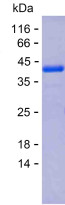
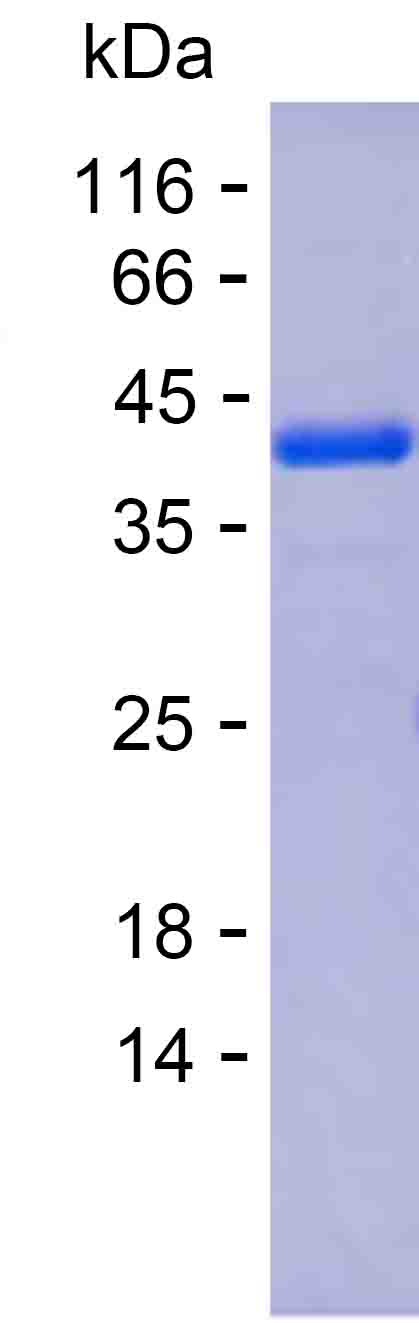
ARG70898 Human MAPK13 / SAPK4 recombinant protein (His-tagged, C-ter) SDS-PAGE image
SDS-PAGE analysis of ARG70898 Human MAPK13 / SAPK4 recombinant protein (His-tagged, C-ter).