ARG70726
Human MMP8 recombinant protein (His-tagged, C-ter)
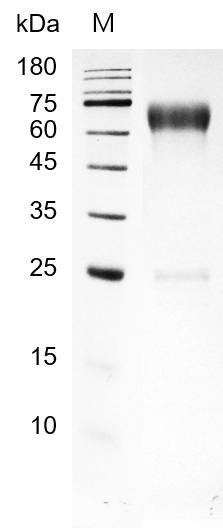
Human MMP8 recombinant protein (His-tagged, C-ter) for SDS-PAGE
Overview
| Product Description | CHO expressed, His-tagged (C-ter) MMP8 recombinant protein |
|---|---|
| Tested Application | SDS-PAGE |
| Target Name | MMP8 |
| Species | Human |
| A.A. Sequence | Phe21 - Gly467 |
| Expression System | CHO |
| Alternate Names | HNC; PMNL collagenase; MMP-8; PMNL-CL; CLG1; Neutrophil collagenase; Matrix metalloproteinase-8; EC 3.4.24.34 |
Properties
| Form | Powder |
|---|---|
| Purification Note | Endotoxin level is less than 0.1 EU/µg of the protein, as determined by the LAL test. |
| Purity | > 95% (by SDS-PAGE) |
| Buffer | PBS (pH 7.4) |
| Reconstitution | It is recommended to reconstitute the lyophilized protein in sterile water to a concentration not less than 200 μg/mL and incubate the stock solution for at least 20 min at room temperature to make sure the protein is dissolved completely. |
| Storage Instruction | For long term, lyophilized protein should be stored at -20°C or -80°C. After reconstitution, aliquot and store at -20°C or -80°C for up to one month. Storage in frost free freezers is not recommended. Avoid repeated freeze/thaw cycles. Suggest spin the vial prior to opening. |
| Note | For laboratory research only, not for drug, diagnostic or other use. |
Bioinformation
| Gene Symbol | MMP8 |
|---|---|
| Gene Full Name | matrix metallopeptidase 8 |
| Background | This gene encodes a member of the matrix metalloproteinase (MMP) family of proteins. These proteins are involved in the breakdown of extracellular matrix in embryonic development, reproduction, and tissue remodeling, as well as in disease processes, such as arthritis and metastasis. Proteolysis at different sites on this protein results in multiple active forms of the enzyme with distinct N-termini. This protein functions in the degradation of type I, II and III collagens. The gene is part of a cluster of MMP genes which localize to chromosome 11q22.3. Alternative splicing results in multiple transcript variants. [provided by RefSeq, Jan 2015] |
| Function | Can degrade fibrillar type I, II, and III collagens. [UniProt] |
| Cellular Localization | Secreted > Extracellular space > Extracellular matrix. [UniProt] |
Images (1) Click the Picture to Zoom In
-

ARG70726 Human MMP8 recombinant protein (His-tagged, C-ter) SDS-PAGE image
SDS-PAGE analysis of ARG70726 Human MMP8 recombinant protein (His-tagged, C-ter).