ARG70643
Human Midkine recombinant protein (His-tagged, C-ter)
Human Midkine recombinant protein (His-tagged, C-ter) for SDS-PAGE
Overview
| Product Description | E. coli expressed, His-tagged (C-ter) Midkine recombinant protein |
|---|---|
| Tested Application | SDS-PAGE |
| Target Name | Midkine |
| Species | Human |
| A.A. Sequence | Val21 - Asp143 |
| Expression System | E. coli |
| Alternate Names | ARAP; Neurite outgrowth-promoting protein; Midkine; MK; Neurite outgrowth-promoting factor 2; Amphiregulin-associated protein; Midgestation and kidney protein; NEGF2 |
Properties
| Form | Powder |
|---|---|
| Purification Note | Endotoxin level is less than 0.1 EU/µg of the protein, as determined by the LAL test. |
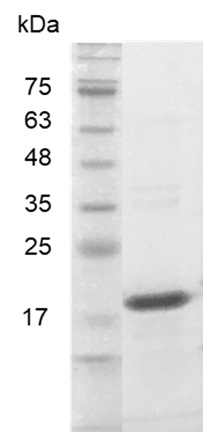
| Purity | > 95% (by SDS-PAGE) |
| Buffer | 20 mM sodium citrate and 0.2 M NaCl (pH 4.5) |
| Reconstitution | It is recommended to reconstitute the lyophilized protein in sterile water to a concentration not less than 200 μg/mL and incubate the stock solution for at least 20 min at room temperature to make sure the protein is dissolved completely. |
| Storage Instruction | For long term, lyophilized protein should be stored at -20°C or -80°C. After reconstitution, aliquot and store at -20°C or -80°C for up to one month. Storage in frost free freezers is not recommended. Avoid repeated freeze/thaw cycles. Suggest spin the vial prior to opening. |
| Note | For laboratory research only, not for drug, diagnostic or other use. |
Bioinformation
| Gene Symbol | MDK |
|---|---|
| Gene Full Name | midkine (neurite growth-promoting factor 2) |
| Background | This gene encodes a member of a small family of secreted growth factors that binds heparin and responds to retinoic acid. The encoded protein promotes cell growth, migration, and angiogenesis, in particular during tumorigenesis. This gene has been targeted as a therapeutic for a variety of different disorders. Alternatively spliced transcript variants encoding multiple isoforms have been observed. [provided by RefSeq, Jul 2012] |
| Function | Developmentally regulated, secreted growth factor homologous to pleiotrophin (PTN), which has heparin binding activity. Binds anaplastic lymphoma kinase (ALK) which induces ALK activation and subsequent phosphorylation of the insulin receptor substrate (IRS1), followed by the activation of mitogen-activated protein kinase (MAPK) and PI3-kinase, and the induction of cell proliferation. Involved in neointima formation after arterial injury, possibly by mediating leukocyte recruitment. Also involved in early fetal adrenal gland development (By similarity). [UniProt] |
Images (1) Click the Picture to Zoom In
-
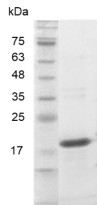
ARG70643 Human Midkine recombinant protein (His-tagged, C-ter) SDS-PAGE image
SDS-PAGE analysis of ARG70643 Human Midkine recombinant protein (His-tagged, C-ter).