ARG70891
Human NOTCH3 recombinant protein (Tag free)
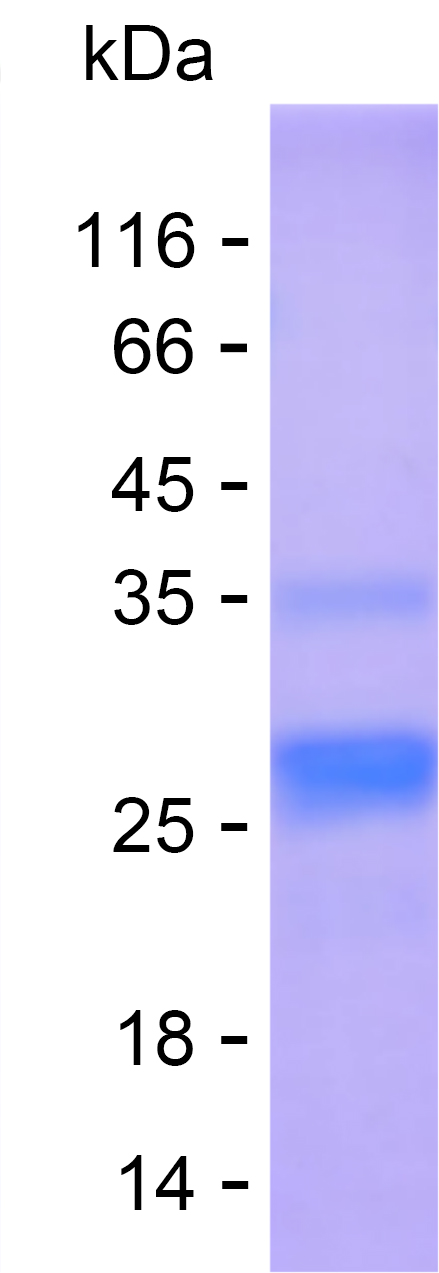
Human NOTCH3 recombinant protein (Tag free) for SDS-PAGE
Overview
| Product Description | HEK293 expressed, Human NOTCH3 recombinant protein |
|---|---|
| Tested Application | SDS-PAGE |
| Target Name | NOTCH3 |
| Species | Human |
| A.A. Sequence | Val1381 - Ser1640 |
| Expression System | HEK293 |
| Alternate Names | LMNS; CADASIL; CASIL; Neurogenic locus notch homolog protein 3; IMF2; Notch 3 |
Properties
| Form | Powder |
|---|---|
| Buffer | PBS |
| Reconstitution | It is recommended to reconstitute the lyophilized protein in sterile water to a concentration approximately 1 mg/mL and incubate the stock solution for at least 20 min at room temperature to make sure the protein is dissolved completely. |
| Storage Instruction | For long term, lyophilized protein should be stored at -20°C or -80°C, protected from light and moisture, for up to 12 months. After reconstitution , aliquot and store at 2 to 8°C for up to 2 days, or at -20°C or -80°C for up to 3 months Storage in frost free freezers is not recommended. Avoid repeated freeze/thaw cycles. Suggest spin the vial prior to opening. |
Bioinformation
| Gene Symbol | NOTCH3 |
|---|---|
| Gene Full Name | notch 3 |
| Background | This gene encodes the third discovered human homologue of the Drosophilia melanogaster type I membrane protein notch. In Drosophilia, notch interaction with its cell-bound ligands (delta, serrate) establishes an intercellular signalling pathway that plays a key role in neural development. Homologues of the notch-ligands have also been identified in human, but precise interactions between these ligands and the human notch homologues remains to be determined. Mutations in NOTCH3 have been identified as the underlying cause of cerebral autosomal dominant arteriopathy with subcortical infarcts and leukoencephalopathy (CADASIL). [provided by RefSeq, Jul 2008] |
| Function | Functions as a receptor for membrane-bound ligands Jagged1, Jagged2 and Delta1 to regulate cell-fate determination. Upon ligand activation through the released notch intracellular domain (NICD) it forms a transcriptional activator complex with RBPJ/RBPSUH and activates genes of the enhancer of split locus. Affects the implementation of differentiation, proliferation and apoptotic programs (By similarity). [UniProt] |
| PTM | Synthesized in the endoplasmic reticulum as an inactive form which is proteolytically cleaved by a furin-like convertase in the trans-Golgi network before it reaches the plasma membrane to yield an active, ligand-accessible form. Cleavage results in a C-terminal fragment N(TM) and a N-terminal fragment N(EC). Following ligand binding, it is cleaved by TNF-alpha converting enzyme (TACE) to yield a membrane-associated intermediate fragment called notch extracellular truncation (NEXT). This fragment is then cleaved by presenilin dependent gamma-secretase to release a notch-derived peptide containing the intracellular domain (NICD) from the membrane (By similarity). Phosphorylated. Hydroxylated by HIF1AN. [UniProt] |
Images (1) Click the Picture to Zoom In
-
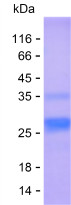
ARG70891 Human NOTCH3 recombinant protein (Tag free) SDS-PAGE image
SDS-PAGE analysis of ARG70891 Human NOTCH3 recombinant protein (Tag free).