ARG70705
Human Nectin 4 recombinant protein (Active) (His-tagged, C-ter)
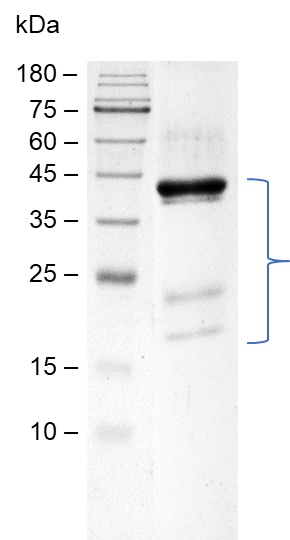
Human Nectin 4 recombinant protein (Active) (His-tagged, C-ter) for SDS-PAGE
Overview
| Product Description | CHO expressed, His-tagged (C-ter) Active Nectin 4 recombinant protein |
|---|---|
| Tested Application | SDS-PAGE |
| Target Name | Nectin 4 |
| Species | Human |
| A.A. Sequence | Gly 32 - Ser 349 |
| Expression System | CHO |
| Activity | Active |
| Activity Note | Determinedd by the ability of the immobilized protein to support the adhesion of NIH-3T3 mouse embryonic fibroblast cells. The ED50 for this effect is less than 0.5 μg/mL. |
| Alternate Names | Nectin-4; Ig superfamily receptor LNIR; PRR4; LNIR; nectin-4; EDSS1; Poliovirus receptor-related protein 4 |
Properties
| Form | Powder |
|---|---|
| Purification Note | Endotoxin level is less than 0.1 EU/µg of the protein, as determined by the LAL test. |
| Purity | > 95% (by SDS-PAGE) |
| Buffer | PBS (pH 7.4) |
| Reconstitution | It is recommended to reconstitute the lyophilized protein in sterile water to a concentration not less than 200 μg/mL and incubate the stock solution for at least 20 min at room temperature to make sure the protein is dissolved completely. |
| Storage Instruction | For long term, lyophilized protein should be stored at -20°C or -80°C. After reconstitution, aliquot and store at -20°C or -80°C for up to one month. Storage in frost free freezers is not recommended. Avoid repeated freeze/thaw cycles. Suggest spin the vial prior to opening. |
| Note | For laboratory research only, not for drug, diagnostic or other use. |
Bioinformation
| Gene Symbol | PVRL4 |
|---|---|
| Gene Full Name | poliovirus receptor-related 4 |
| Background | This gene encodes a member of the nectin family. The encoded protein contains two immunoglobulin-like (Ig-like) C2-type domains and one Ig-like V-type domain. It is involved in cell adhesion through trans-homophilic and -heterophilic interactions. It is a single-pass type I membrane protein. The soluble form is produced by proteolytic cleavage at the cell surface by the metalloproteinase ADAM17/TACE. The secreted form is found in both breast tumor cell lines and breast tumor patients. Mutations in this gene are the cause of ectodermal dysplasia-syndactyly syndrome type 1, an autosomal recessive disorder. Alternatively spliced transcript variants have been found but the full-length nature of the variant has not been determined. [provided by RefSeq, Jan 2011] |
| Function | Seems to be involved in cell adhesion through trans-homophilic and -heterophilic interactions, the latter including specifically interactions with NECTIN1. Does not act as receptor for alpha-herpesvirus entry into cells. (Microbial infection) Acts as a receptor for measles virus. [UniProt] |
| Cellular Localization | Cell membrane; Single-pass type I membrane protein. Cell junction, adherens junction. Note=Colocalizes with AFDN at cadherin-based adherens junctions (PubMed:11544254). Processed poliovirus receptor-related protein 4: Secreted. Note=The secreted form is found in breast tumor patients (PubMed:15784625). [UniProt] |
| PTM | The soluble form is produced by proteolytic cleavage at the cell surface (shedding), probably by ADAM17/TACE. [UniProt] |
Images (1) Click the Picture to Zoom In
-
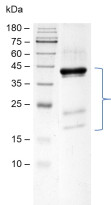
ARG70705 Human Nectin 4 recombinant protein (Active) (His-tagged, C-ter) SDS-PAGE image
SDS-PAGE analysis of ARG70705 Human Nectin 4 recombinant protein (Active) (His-tagged, C-ter).