ARG70762
Human PCSK9 recombinant protein (His-tagged, C-ter)
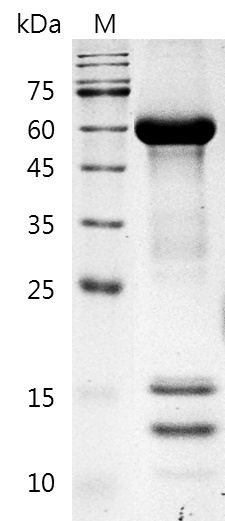
Human PCSK9 recombinant protein (His-tagged, C-ter) for SDS-PAGE
Overview
| Product Description | CHO expressed, His-tagged (C-ter) PCSK9 recombinant protein |
|---|---|
| Tested Application | SDS-PAGE |
| Target Name | PCSK9 |
| Species | Human |
| A.A. Sequence | Met1 - Gln692 |
| Expression System | CHO |
| Alternate Names | PC9; Subtilisin/kexin-like protease PC9; Proprotein convertase 9; Proprotein convertase subtilisin/kexin type 9; Neural apoptosis-regulated convertase 1; FH3; EC 3.4.21.-; HCHOLA3; NARC1; LDLCQ1; NARC-1 |
Properties
| Form | Powder |
|---|---|
| Purification Note | Endotoxin level is less than 0.1 EU/µg of the protein, as determined by the LAL test. |
| Purity | > 85% (by SDS-PAGE) |
| Buffer | PBS (pH 7.4) |
| Reconstitution | It is recommended to reconstitute the lyophilized protein in 4 mM HCl to a concentration not less than 200 μg/mL and incubate the stock solution for at least 20 min at room temperature to make sure the protein is dissolved completely. |
| Storage Instruction | For long term, lyophilized protein should be stored at -20°C or -80°C. After reconstitution, aliquot and store at -20°C or -80°C for up to one month. Storage in frost free freezers is not recommended. Avoid repeated freeze/thaw cycles. Suggest spin the vial prior to opening. |
| Note | For laboratory research only, not for drug, diagnostic or other use. |
Bioinformation
| Gene Symbol | PCSK9 |
|---|---|
| Gene Full Name | proprotein convertase subtilisin/kexin type 9 |
| Background | This gene encodes a member of the subtilisin-like proprotein convertase family, which includes proteases that process protein and peptide precursors trafficking through regulated or constitutive branches of the secretory pathway. The encoded protein undergoes an autocatalytic processing event with its prosegment in the ER and is constitutively secreted as an inactive protease into the extracellular matrix and trans-Golgi network. It is expressed in liver, intestine and kidney tissues and escorts specific receptors for lysosomal degradation. It plays a role in cholesterol and fatty acid metabolism. Mutations in this gene have been associated with autosomal dominant familial hypercholesterolemia. Alternative splicing results in multiple transcript variants. [provided by RefSeq, Feb 2014] |
| Function | Crucial player in the regulation of plasma cholesterol homeostasis. Binds to low-density lipid receptor family members: low density lipoprotein receptor (LDLR), very low density lipoprotein receptor (VLDLR), apolipoprotein E receptor (LRP1/APOER) and apolipoprotein receptor 2 (LRP8/APOER2), and promotes their degradation in intracellular acidic compartments. Acts via a non-proteolytic mechanism to enhance the degradation of the hepatic LDLR through a clathrin LDLRAP1/ARH-mediated pathway. May prevent the recycling of LDLR from endosomes to the cell surface or direct it to lysosomes for degradation. Can induce ubiquitination of LDLR leading to its subsequent degradation. Inhibits intracellular degradation of APOB via the autophagosome/lysosome pathway in a LDLR-independent manner. Involved in the disposal of non-acetylated intermediates of BACE1 in the early secretory pathway. Inhibits epithelial Na(+) channel (ENaC)-mediated Na(+) absorption by reducing ENaC surface expression primarily by increasing its proteasomal degradation. Regulates neuronal apoptosis via modulation of LRP8/APOER2 levels and related anti-apoptotic signaling pathways. [UniProt] |
| Cellular Localization | Cytoplasm, Endoplasmic reticulum, Endosome, Golgi apparatus, Lysosome, Secreted |
| PTM | Cleavage by furin and PCSK5 generates a truncated inactive protein that is unable to induce LDLR degradation. Undergoes autocatalytic cleavage in the endoplasmic reticulum to release the propeptide from the N-terminus and the cleavage of the propeptide is strictly required for its maturation and activation. The cleaved propeptide however remains associated with the catalytic domain through non-covalent interactions, preventing potential substrates from accessing its active site. As a result, it is secreted from cells as a propeptide-containing, enzymatically inactive protein. Phosphorylation protects the propeptide against proteolysis. |
Images (1) Click the Picture to Zoom In
-
ARG70762 Human PCSK9 recombinant protein (His-tagged, C-ter) SDS-PAGE image
SDS-PAGE analysis of ARG70762 Human PCSK9 recombinant protein (His-tagged, C-ter).