ARG70710
Human PLAUR recombinant protein (His-tagged, C-ter)
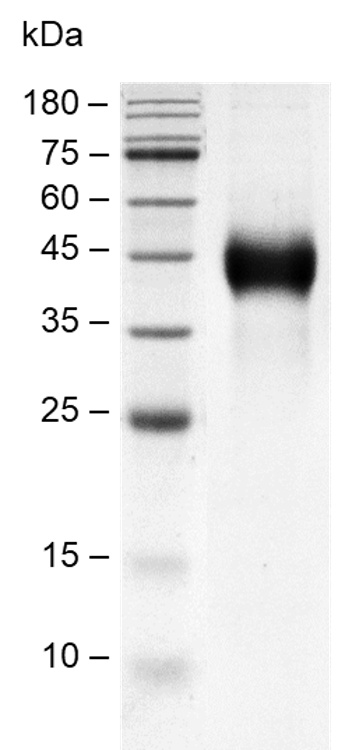
Human PLAUR recombinant protein (His-tagged, C-ter) for SDS-PAGE
Overview
| Product Description | CHO expressed, His-tagged (C-ter) PLAUR recombinant protein |
|---|---|
| Tested Application | SDS-PAGE |
| Target Name | PLAUR |
| Species | Human |
| A.A. Sequence | Leu23 - Arg303 |
| Expression System | CHO |
| Alternate Names | Monocyte activation antigen Mo3; CD antigen CD87; uPAR; U-PAR; URKR; Urokinase plasminogen activator surface receptor; UPAR; CD87 |
Properties
| Form | Powder |
|---|---|
| Purification Note | Endotoxin level is less than 0.1 EU/µg of the protein, as determined by the LAL test. |
| Purity | > 95% (by SDS-PAGE) |
| Buffer | PBS (pH 7.4) |
| Reconstitution | It is recommended to reconstitute the lyophilized protein in sterile water to a concentration not less than 200 μg/mL and incubate the stock solution for at least 20 min at room temperature to make sure the protein is dissolved completely. |
| Storage Instruction | For long term, lyophilized protein should be stored at -20°C or -80°C. After reconstitution, aliquot and store at -20°C or -80°C for up to one month. Storage in frost free freezers is not recommended. Avoid repeated freeze/thaw cycles. Suggest spin the vial prior to opening. |
| Note | For laboratory research only, not for drug, diagnostic or other use. |
Bioinformation
| Gene Symbol | PLAUR |
|---|---|
| Gene Full Name | Plasminogen Activator, Urokinase Receptor |
| Background | uPAR (Urokinase plasminogen activator receptor) is a 55 kDa glycoprotein I-anchored surface receptor specific for urokinase plasminogen activator (uPA). Upon binding to uPAR, uPA converts the surface bound, large serum β-globulin, plasminogen to plasmin. Plasmin, which is also designated fibrinolysin, is a trypsin-like enzyme that acts on Arg-Lys bonds and induces pericellular proteolysis in fibrin and fibrinogen, and thereby contributes to the systematic activation of the coagulation cascade. uPA and uPAR are known to be overexpressed in mesenchymal and epithelial tumor cells and are required for tumor invasion and metastasis. |
Images (1) Click the Picture to Zoom In
-

ARG70710 Human PLAUR recombinant protein (His-tagged, C-ter) SDS-PAGE image
SDS-PAGE analysis of ARG70710 Human PLAUR recombinant protein (His-tagged, C-ter).