ARG70927
Human PSMB4 recombinant protein (GST-tagged, N-ter / His-tagged, C-ter)
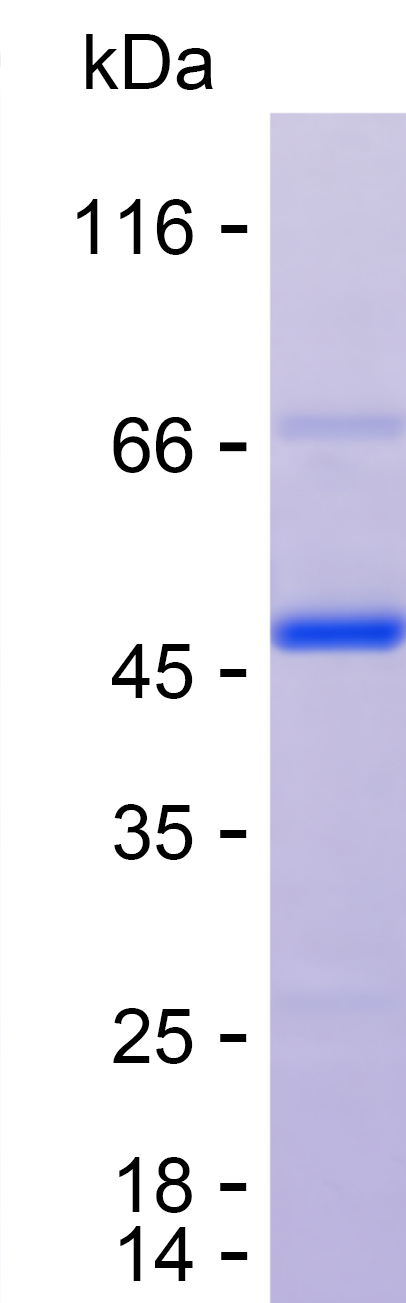
Human PSMB4 recombinant protein (GST-tagged, N-ter / His-tagged, C-ter) for SDS-PAGE
Overview
| Product Description | HEK293 expressed, Human GST-tagged (N-ter) / His-tagged (C-ter) PSMB4 recombinant protein |
|---|---|
| Tested Application | SDS-PAGE |
| Target Name | PSMB4 |
| Species | Human |
| A.A. Sequence | Thr46 - Glu264 |
| Expression System | HEK293 |
| Alternate Names | Proteasome chain 3; PROS-26; Proteasome subunit beta type-4; HsBPROS26; PROS26; Macropain beta chain; HN3; 26 kDa prosomal protein; EC 3.4.25.1; Proteasome beta chain; HsN3; Multicatalytic endopeptidase complex beta chain |
Properties
| Form | Powder |
|---|---|
| Buffer | PBS |
| Reconstitution | It is recommended to reconstitute the lyophilized protein in sterile water to a concentration approximately 1 mg/mL and incubate the stock solution for at least 20 min at room temperature to make sure the protein is dissolved completely. |
| Storage Instruction | For long term, lyophilized protein should be stored at -20°C or -80°C, protected from light and moisture, for up to 12 months. After reconstitution , aliquot and store at 2 to 8°C for up to 2 days, or at -20°C or -80°C for up to 3 months Storage in frost free freezers is not recommended. Avoid repeated freeze/thaw cycles. Suggest spin the vial prior to opening. |
Bioinformation
| Gene Symbol | PSMB4 |
|---|---|
| Gene Full Name | proteasome subunit beta 4 |
| Background | The proteasome is a multicatalytic proteinase complex with a highly ordered ring-shaped 20S core structure. The core structure is composed of 4 rings of 28 non-identical subunits; 2 rings are composed of 7 alpha subunits and 2 rings are composed of 7 beta subunits. Proteasomes are distributed throughout eukaryotic cells at a high concentration and cleave peptides in an ATP/ubiquitin-dependent process in a non-lysosomal pathway. An essential function of a modified proteasome, the immunoproteasome, is the processing of class I MHC peptides. This gene encodes a member of the proteasome B-type family, also known as the T1B family, that is a 20S core beta subunit. [provided by RefSeq, Jul 2008] |
| Function | The proteasome is a multicatalytic proteinase complex which is characterized by its ability to cleave peptides with Arg, Phe, Tyr, Leu, and Glu adjacent to the leaving group at neutral or slightly basic pH. The proteasome has an ATP-dependent proteolytic activity. Mediates the lipopolysaccharide-induced signal macrophage proteasome (By similarity). SMAD1/OAZ1/PSMB4 complex mediates the degradation of the CREBBP/EP300 repressor SNIP1. [UniProt] |
| Cellular Localization | Cytoplasm. Nucleus. [UniProt] |
Images (1) Click the Picture to Zoom In
-
ARG70927 Human PSMB4 recombinant protein (GST-tagged, N-ter / His-tagged, C-ter) SDS-PAGE image
SDS-PAGE analysis of ARG70927 Human PSMB4 recombinant protein (GST-tagged, N-ter / His-tagged, C-ter).