ARG70909
Human Presenilin 2 / PS2 recombinant protein (His-tagged, C-ter)
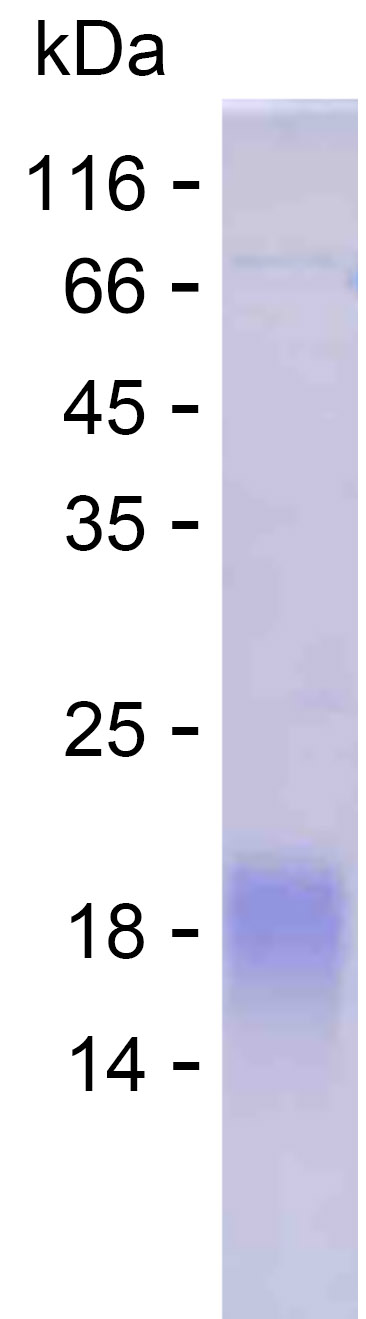
Human Presenilin 2 / PS2 recombinant protein (His-tagged, C-ter) for SDS-PAGE
Overview
| Product Description | E. coli expressed, His-tagged (C-ter) Presenilin 2 / PS2 recombinant protein |
|---|---|
| Tested Application | SDS-PAGE |
| Target Name | Presenilin 2 / PS2 |
| Species | Human |
| A.A. Sequence | Glu11 - Thr80 |
| Expression System | E. coli |
| Alternate Names | AD4; AD5; EC 3.4.23.-; STM2; STM-2; AD3LP; Presenilin-2; CMD1V; PS2; AD3L; E5-1; PS-2 |
Properties
| Form | Powder |
|---|---|
| Buffer | PBS |
| Reconstitution | It is recommended to reconstitute the lyophilized protein in sterile water to a concentration approximately 1 mg/mL and incubate the stock solution for at least 20 min at room temperature to make sure the protein is dissolved completely. |
| Storage Instruction | For long term, lyophilized protein should be stored at -20°C or -80°C, protected from light and moisture, for up to 12 months. After reconstitution , aliquot and store at 2 to 8°C for up to 2 days, or at -20°C or -80°C for up to 3 months Storage in frost free freezers is not recommended. Avoid repeated freeze/thaw cycles. Suggest spin the vial prior to opening. |
Bioinformation
| Gene Symbol | PSEN2 |
|---|---|
| Gene Full Name | presenilin 2 |
| Background | Alzheimer's disease (AD) patients with an inherited form of the disease carry mutations in the presenilin proteins (PSEN1 or PSEN2) or the amyloid precursor protein (APP). These disease-linked mutations result in increased production of the longer form of amyloid-beta (main component of amyloid deposits found in AD brains). Presenilins are postulated to regulate APP processing through their effects on gamma-secretase, an enzyme that cleaves APP. Also, it is thought that the presenilins are involved in the cleavage of the Notch receptor such that, they either directly regulate gamma-secretase activity, or themselves act are protease enzymes. Two alternatively spliced transcript variants encoding different isoforms of PSEN2 have been identified. [provided by RefSeq, Jul 2008] |
| Function | Probable catalytic subunit of the gamma-secretase complex, an endoprotease complex that catalyzes the intramembrane cleavage of integral membrane proteins such as Notch receptors and APP (amyloid-beta precursor protein). Requires the other members of the gamma-secretase complex to have a protease activity. May play a role in intracellular signaling and gene expression or in linking chromatin to the nuclear membrane. May function in the cytoplasmic partitioning of proteins. The holoprotein functions as a calcium-leak channel that allows the passive movement of calcium from endoplasmic reticulum to cytosol and is involved in calcium homeostasis (PubMed:16959576). Is a regulator of mitochondrion-endoplasmic reticulum membrane tethering and modulates calcium ions shuttling between ER and mitochondria (PubMed:21285369). [UniProt] |
| Cellular Localization | Endoplasmic reticulum membrane; Multi-pass membrane protein. Golgi apparatus membrane; Multi-pass membrane protein. [UniProt] |
| PTM | Heterogeneous proteolytic processing generates N-terminal and C-terminal fragments. Phosphorylated on serine residues. [UniProt] |
Images (1) Click the Picture to Zoom In
-
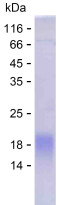
ARG70909 Human Presenilin 2 / PS2 recombinant protein (His-tagged, C-ter) SDS-PAGE image
SDS-PAGE analysis of ARG70909 Human Presenilin 2 / PS2 recombinant protein (His-tagged, C-ter).