ARG83796
Human RANK Ligand / TNFSF11 / TRANCE ELISA Kit
Human RANK Ligand / TNFSF11 / TRANCE ELISA Kit for ELISA and Human
Overview
| Product Description | ARG83796 Human RANK Ligand / TNFSF11 / TRANCE ELISA Kit is an Enzyme Immunoassay kit for the quantification of Human RANK Ligand / TNFSF11 / TRANCE in serum, plasma and cell culture supernatants. |
|---|---|
| Tested Reactivity | Hu |
| Tested Application | ELISA |
| Target Name | RANK Ligand / TNFSF11 / TRANCE |
| Conjugation | HRP |
| Conjugation Note | Substrate: TMB and read at 450 nm. |
| Sensitivity | 31.25 pg/ml |
| Sample Type | Serum, Plasma and Cell culture supernatants. |
| Standard Range | 62.5 – 4000 pg/ml |
| Sample Volume | 50 µl |
| Precision | Intra-Assay CV: < 10% Inter-Assay CV: < 10% |
| Alternate Names | TRANCE; Osteoprotegerin ligand; CD254; sOdf; Receptor activator of nuclear factor kappa-B ligand; OPTB2; RANKL; OPGL; Tumor necrosis factor ligand superfamily member 11; hRANKL2; TNF-related activation-induced cytokine; Osteoclast differentiation factor; ODF; CD antigen CD254 |
Application Instructions
| Assay Time | 4 hours |
|---|
Properties
| Form | 96 well |
|---|---|
| Storage Instruction | Store the kit at 4°C, -20°C. Keep microplate wells sealed in a dry bag with desiccants. Do not expose test reagents to heat, sun or strong light during storage and usage. Please refer to the product user manual for detail temperatures of the components. |
| Note | For laboratory research only, not for drug, diagnostic or other use. |
Bioinformation
| Database Links |
Swiss-port # O14788 Human Tumor necrosis factor ligand superfamily member 11 |
|---|---|
| Gene Symbol | TNFSF11 |
| Gene Full Name | tumor necrosis factor (ligand) superfamily, member 11 |
| Background | This gene encodes a member of the tumor necrosis factor (TNF) cytokine family which is a ligand for osteoprotegerin and functions as a key factor for osteoclast differentiation and activation. This protein was shown to be a dentritic cell survival factor and is involved in the regulation of T cell-dependent immune response. T cell activation was reported to induce expression of this gene and lead to an increase of osteoclastogenesis and bone loss. This protein was shown to activate antiapoptotic kinase AKT/PKB through a signaling complex involving SRC kinase and tumor necrosis factor receptor-associated factor (TRAF) 6, which indicated this protein may have a role in the regulation of cell apoptosis. Targeted disruption of the related gene in mice led to severe osteopetrosis and a lack of osteoclasts. The deficient mice exhibited defects in early differentiation of T and B lymphocytes, and failed to form lobulo-alveolar mammary structures during pregnancy. Two alternatively spliced transcript variants have been found. [provided by RefSeq, Jul 2008] |
| Function | Cytokine that binds to TNFRSF11B/OPG and to TNFRSF11A/RANK. Osteoclast differentiation and activation factor. Augments the ability of dendritic cells to stimulate naive T-cell proliferation. May be an important regulator of interactions between T-cells and dendritic cells and may play a role in the regulation of the T-cell-dependent immune response. May also play an important role in enhanced bone-resorption in humoral hypercalcemia of malignancy. [UniProt] |
Images (1) Click the Picture to Zoom In
-
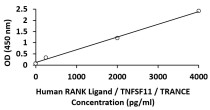
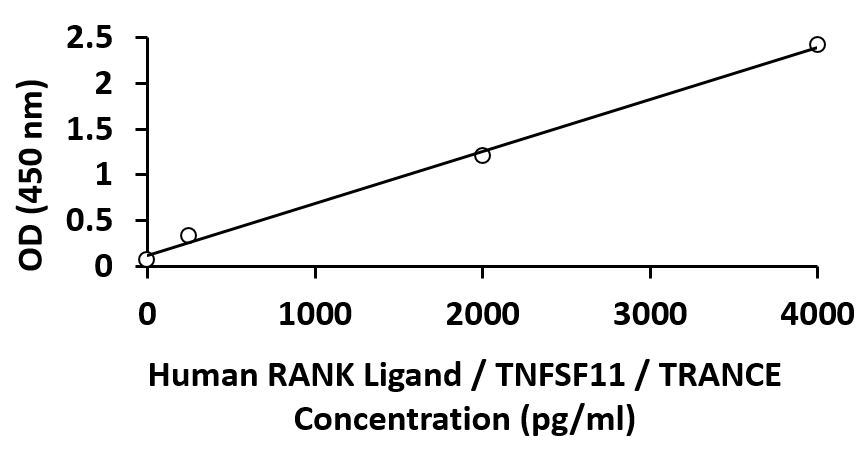
ARG83796 Human RANK Ligand / TNFSF11 / TRANCE ELISA Kit standard curve image
ARG83796 Human RANK Ligand / TNFSF11 / TRANCE ELISA Kit results of a typical standard run with optical density reading at 450 nm.
| Title | Download Link |
|---|---|
| Human RANK Ligand / TNFSF11 / TRANCE ELISA Kit User manual |
 Download Download
|