ARG70873
Human RPS20 recombinant protein (His-tagged, C-ter)
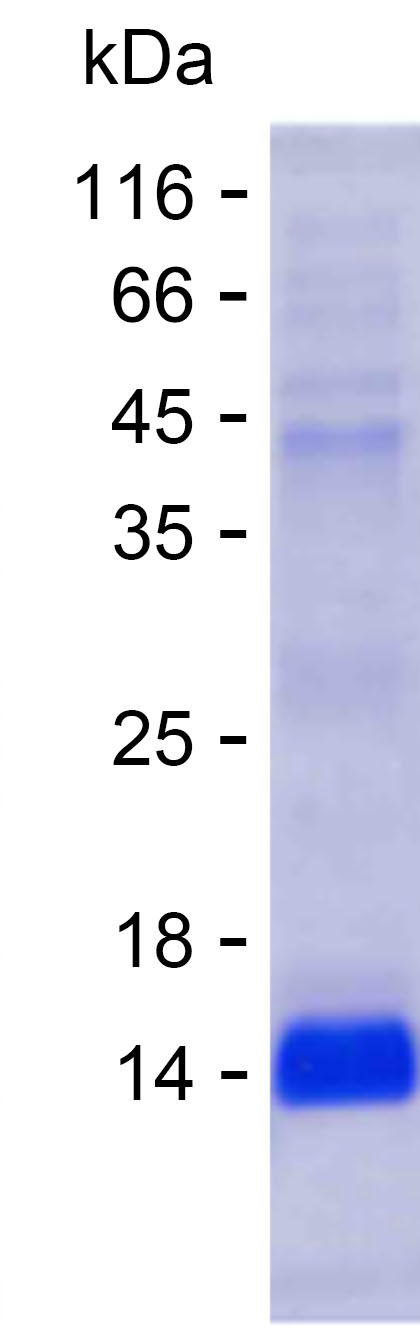
Human RPS20 recombinant protein (His-tagged, C-ter) for SDS-PAGE
Overview
| Product Description | E. coli expressed, His-tagged (C-ter) RPS20 recombinant protein |
|---|---|
| Tested Application | SDS-PAGE |
| Target Name | RPS20 |
| Species | Human |
| A.A. Sequence | Val11 - Asp90 |
| Expression System | E. coli |
| Alternate Names | S20; 40S ribosomal protein S20 |
Properties
| Form | Powder |
|---|---|
| Buffer | PBS |
| Reconstitution | It is recommended to reconstitute the lyophilized protein in sterile water to a concentration approximately 1 mg/mL and incubate the stock solution for at least 20 min at room temperature to make sure the protein is dissolved completely. |
| Storage Instruction | For long term, lyophilized protein should be stored at -20°C or -80°C, protected from light and moisture, for up to 12 months. After reconstitution , aliquot and store at 2 to 8°C for up to 2 days, or at -20°C or -80°C for up to 3 months Storage in frost free freezers is not recommended. Avoid repeated freeze/thaw cycles. Suggest spin the vial prior to opening. |
Bioinformation
| Gene Symbol | RPS20 |
|---|---|
| Gene Full Name | ribosomal protein S20 |
| Background | Ribosomes, the organelles that catalyze protein synthesis, consist of a small 40S subunit and a large 60S subunit. Together these subunits are composed of 4 RNA species and approximately 80 structurally distinct proteins. This gene encodes a ribosomal protein that is a component of the 40S subunit. The protein belongs to the S10P family of ribosomal proteins. It is located in the cytoplasm. This gene is co-transcribed with the small nucleolar RNA gene U54, which is located in its second intron. As is typical for genes encoding ribosomal proteins, there are multiple processed pseudogenes of this gene dispersed through the genome. Two transcript variants encoding different isoforms have been identified for this gene. [provided by RefSeq, Apr 2009] |
| Cellular Localization | Cytoplasm. [UniProt] |
| PTM | Monoubiquitinated by ZNF598 when a ribosome has stalled during translation of poly(A) sequences, leading to preclude synthesis of a long poly-lysine tail and initiate the ribosome quality control (RQC) pathway to degrade the potentially detrimental aberrant nascent polypeptide (PubMed:28065601, PubMed:28132843). [UniProt] |
Images (1) Click the Picture to Zoom In
-
ARG70873 Human RPS20 recombinant protein (His-tagged, C-ter) SDS-PAGE image
SDS-PAGE analysis of ARG70873 Human RPS20 recombinant protein (His-tagged, C-ter).