ARG70893
Human SNX9 recombinant protein (His-tagged, C-ter)
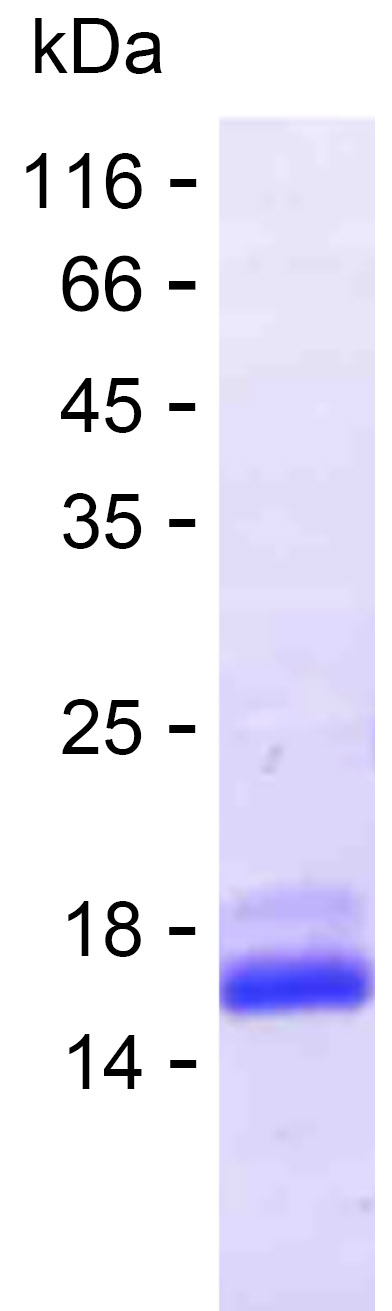
Human SNX9 recombinant protein (His-tagged, C-ter) for SDS-PAGE
Overview
| Product Description | E. coli expressed, His-tagged (C-ter) SNX9 recombinant protein |
|---|---|
| Tested Application | SDS-PAGE |
| Target Name | SNX9 |
| Species | Human |
| A.A. Sequence | Pro141 - Glu230 |
| Expression System | E. coli |
| Alternate Names | SDP1; SH3 and PX domain-containing protein 3A; SH3PX1; WISP; Sorting nexin-9; SH3 and PX domain-containing protein 1; Protein SDP1; SH3PXD3A |
Properties
| Form | Powder |
|---|---|
| Buffer | PBS |
| Reconstitution | It is recommended to reconstitute the lyophilized protein in sterile water to a concentration approximately 1 mg/mL and incubate the stock solution for at least 20 min at room temperature to make sure the protein is dissolved completely. |
| Storage Instruction | For long term, lyophilized protein should be stored at -20°C or -80°C, protected from light and moisture, for up to 12 months. After reconstitution , aliquot and store at 2 to 8°C for up to 2 days, or at -20°C or -80°C for up to 3 months Storage in frost free freezers is not recommended. Avoid repeated freeze/thaw cycles. Suggest spin the vial prior to opening. |
Bioinformation
| Gene Symbol | SNX9 |
|---|---|
| Gene Full Name | Sorting nexin 9 |
| Background | This gene encodes a member of the sorting nexin family. Members of this family contain a phox (PX) domain, which is a phosphoinositide binding domain, and are involved in intracellular trafficking. This protein does not contain a coiled coil region, like some family members, but does contain a SH3 domain near its N-terminus. This protein interacts with the cytoplasmic domains of the precursor but not the processed forms of a disintegrin and metalloprotease domain 9 and 15. This protein binds the beta-appendage domain of adaptor protein 2 and may function to assist adaptor protein 2 in its role at the plasma membrane. This protein interacts with activated Cdc42-associated kinase-2 to regulate the degradation of epidermal growth factor receptor protein. [provided by RefSeq, Jul 2008] |
| PTM | Ubiquitinated by ITCH. Phosphorylated on tyrosine residues by TNK2. Phosphorylation promotes its activity in the degradation of EGFR. |
Images (1) Click the Picture to Zoom In
-
ARG70893 Human SNX9 recombinant protein (His-tagged, C-ter) SDS-PAGE image
SDS-PAGE analysis of ARG70893 Human SNX9 recombinant protein (His-tagged, C-ter).