ARG70894
Human Sonic Hedgehog recombinant protein (His-tagged and MBP-tagged and His-tagged, N-ter)
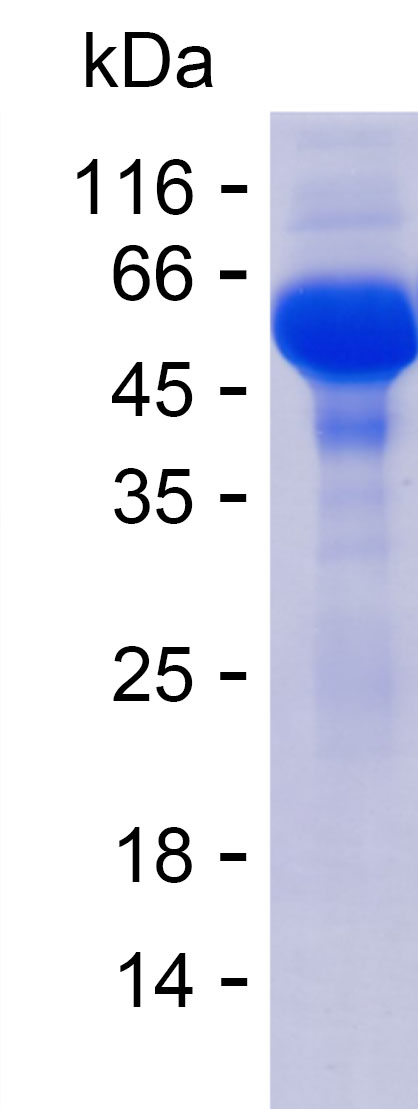
Human Sonic Hedgehog recombinant protein (His-tagged and MBP-tagged and His-tagged, N-ter) for SDS-PAGE
Overview
| Product Description | HEK293 expressed, Human His-tagged and MBP-tagged and His-tagged (N-ter) Sonic Hedgehog recombinant protein |
|---|---|
| Tested Application | SDS-PAGE |
| Target Name | Sonic Hedgehog |
| Species | Human |
| A.A. Sequence | Gly31 - Ser190 |
| Expression System | HEK293 |
| Alternate Names | HPE3; Sonic hedgehog protein; MCOPCB5; HHG-1; HLP3; HHG1; TPT; TPTPS; SHH; SMMCI |
Properties
| Form | Powder |
|---|---|
| Buffer | PBS |
| Reconstitution | It is recommended to reconstitute the lyophilized protein in sterile water to a concentration approximately 1 mg/mL and incubate the stock solution for at least 20 min at room temperature to make sure the protein is dissolved completely. |
| Storage Instruction | For long term, lyophilized protein should be stored at -20°C or -80°C, protected from light and moisture, for up to 12 months. After reconstitution , aliquot and store at 2 to 8°C for up to 2 days, or at -20°C or -80°C for up to 3 months Storage in frost free freezers is not recommended. Avoid repeated freeze/thaw cycles. Suggest spin the vial prior to opening. |
Bioinformation
| Gene Symbol | CD40 |
|---|---|
| Gene Full Name | CD40 molecule |
| Background | This gene encodes a protein that is instrumental in patterning the early embryo. It has been implicated as the key inductive signal in patterning of the ventral neural tube, the anterior-posterior limb axis, and the ventral somites. Of three human proteins showing sequence and functional similarity to the sonic hedgehog protein of Drosophila, this protein is the most similar. The protein is made as a precursor that is autocatalytically cleaved; the N-terminal portion is soluble and contains the signalling activity while the C-terminal portion is involved in precursor processing. More importantly, the C-terminal product covalently attaches a cholesterol moiety to the N-terminal product, restricting the N-terminal product to the cell surface and preventing it from freely diffusing throughout the developing embryo. Defects in this protein or in its signalling pathway are a cause of holoprosencephaly (HPE), a disorder in which the developing forebrain fails to correctly separate into right and left hemispheres. HPE is manifested by facial deformities. It is also thought that mutations in this gene or in its signalling pathway may be responsible for VACTERL syndrome, which is characterized by vertebral defects, anal atresia, tracheoesophageal fistula with esophageal atresia, radial and renal dysplasia, cardiac anomalies, and limb abnormalities. Additionally, mutations in a long range enhancer located approximately 1 megabase upstream of this gene disrupt limb patterning and can result in preaxial polydactyly. [provided by RefSeq, Jul 2008] |
| Function | Intercellular signal essential for a variety of patterning events during development: signal produced by the notochord that induces ventral cell fate in the neural tube and somites, and the polarizing signal for patterning of the anterior-posterior axis of the developing limb bud. Displays both floor plate- and motor neuron-inducing activity. The threshold concentration of N-product required for motor neuron induction is 5-fold lower than that required for floor plate induction. Activates the transcription of target genes by interacting with its receptor PTCH1 to prevent normal inhibition by PTCH1 on the constitutive signaling activity of SMO (By similarity). [UniProt] |
| Cellular Localization | Sonic hedgehog protein C-product: Secreted, extracellular space. The C-terminal peptide diffuses from the cell. [UniProt] |
| PTM | The C-terminal domain displays an autoproteolysis activity and a cholesterol transferase activity. Both activities result in the cleavage of the full-length protein and covalent attachment of a cholesterol moiety to the C-terminal of the newly generated N-terminal fragment (N-product). The N-product is the active species in both local and long-range signaling, whereas the C-product has no signaling activity. Cholesterylation is required for N-product targeting to lipid rafts and multimerization. N-palmitoylation of Cys-24 by HHAT is required for N-product multimerization and full activity. [UniProt] |
Images (1) Click the Picture to Zoom In
-
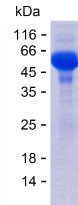
ARG70894 Human Sonic Hedgehog recombinant protein (His-tagged and MBP-tagged and His-tagged, N-ter) SDS-PAGE image
SDS-PAGE analysis of ARG70894 Human Sonic Hedgehog recombinant protein (His-tagged and MBP-tagged and His-tagged, N-ter).