ARG70670
Human TIGIT recombinant protein (Active) (His-tagged, C-ter)
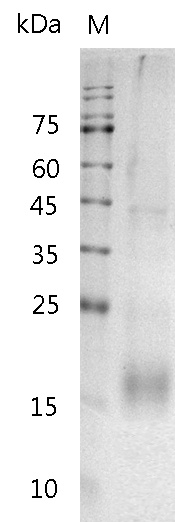
Human TIGIT recombinant protein (Active) (His-tagged, C-ter) for SDS-PAGE
Overview
| Product Description | CHO expressed, His-tagged (C-ter) Active TIGIT recombinant protein |
|---|---|
| Tested Application | SDS-PAGE |
| Target Name | TIGIT |
| Species | Human |
| A.A. Sequence | Met1 - Pro141 |
| Expression System | CHO |
| Activity | Active |
| Activity Note | Determinedd by flow cytometry for its ability to bind a ligand expressed in A549 human lung carcinoma epithelial cell. |
| Alternate Names | TIGIT; T Cell Immunoreceptor With Ig And ITIM Domains; VSIG9; VSTM3; V-Set And Immunoglobulin Domain-Containing Protein 9; V-Set And Transmembrane Domain-Containing Protein 3; T-Cell Immunoreceptor With Ig And ITIM Domains; DKFZp667A205; VSIG9, VSTM3; FLJ39873; V-Set And Immunoglobulin Domain Containing 9; Washington University Cell Adhesion Molecule 3; V-Set And Transmembrane Domain Containing 3; WUCAM |
Properties
| Form | Powder |
|---|---|
| Purification Note | Endotoxin level is less than 0.1 EU/µg of the protein, as determined by the LAL test. |
| Purity | > 95% by SDS-PAGE gel and HPLC analyses. |
| Buffer | PBS (pH 7.4) |
| Reconstitution | It is recommended to reconstitute the lyophilized protein in sterile water to a concentration not less than 200 μg/mL and incubate the stock solution for at least 20 min at room temperature to make sure the protein is dissolved completely. |
| Storage Instruction | For long term, lyophilized protein should be stored at -20°C or -80°C. After reconstitution, aliquot and store at -20°C or -80°C for up to one month. Storage in frost free freezers is not recommended. Avoid repeated freeze/thaw cycles. Suggest spin the vial prior to opening. |
| Note | For laboratory research only, not for drug, diagnostic or other use. |
Bioinformation
| Gene Symbol | TIGIT |
|---|---|
| Gene Full Name | T cell immunoreceptor with Ig and ITIM domains |
| Background | This gene encodes a member of the PVR (poliovirus receptor) family of immunoglobin proteins. The product of this gene is expressed on several classes of T cells including follicular B helper T cells (TFH). The protein has been shown to bind PVR with high affinity; this binding is thought to assist interactions between TFH and dendritic cells to regulate T cell dependent B cell responses. |
| Function | Binds with high affinity to the poliovirus receptor (PVR) which causes increased secretion of IL10 and decreased secretion of IL12B and suppresses T-cell activation by promoting the generation of mature immunoregulatory dendritic cells. |
| Cellular Localization | Cell membrane, Membrane |
| PTM | Disulfide bond, Glycoprotein |
Images (1) Click the Picture to Zoom In
-

ARG70670 Human TIGIT recombinant protein (Active) (His-tagged, C-ter) SDS-PAGE image
SDS-PAGE analysis of ARG70670 Human TIGIT recombinant protein (Active) (His-tagged, C-ter).