ARG70642
Human TNFSF10 recombinant protein (Active) (His-tagged, C-ter)
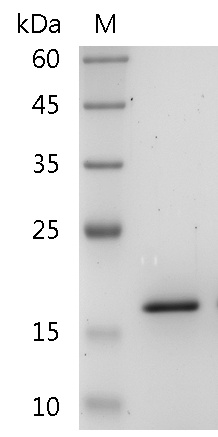
Human TNFSF10 recombinant protein (Active) (His-tagged, C-ter) for SDS-PAGE
Overview
| Product Description | E. coli expressed, His-tagged (C-ter) Active TNFSF10 recombinant protein |
|---|---|
| Tested Application | SDS-PAGE |
| Target Name | TNFSF10 |
| Species | Human |
| A.A. Sequence | Arg114 - Gly281 |
| Expression System | E. coli |
| Activity | Active |
| Activity Note | Determined by its ability to induce cytotoxicity in L929 cells in the presence of actinomycin D. The ED₅₀ for this effect is 10.4-15.4 ng/mL. |
| Alternate Names | TL2; CD253; Protein TRAIL; TNF-related apoptosis-inducing ligand; TRAIL; CD antigen CD253; Apo-2 ligand; Apo-2L; APO2L; Tumor necrosis factor ligand superfamily member 10 |
Properties
| Form | Powder |
|---|---|
| Purification Note | Endotoxin level is less than 0.1 EU/µg of the protein, as determined by the LAL test. |
| Purity | > 98% (by SDS-PAGE) |
| Buffer | PBS (pH 8.0) |
| Reconstitution | It is recommended to reconstitute the lyophilized protein in sterile water to a concentration not less than 200 μg/mL and incubate the stock solution for at least 20 min at room temperature to make sure the protein is dissolved completely. |
| Storage Instruction | For long term, lyophilized protein should be stored at -20°C or -80°C. After reconstitution, aliquot and store at -20°C or -80°C for up to one month. Storage in frost free freezers is not recommended. Avoid repeated freeze/thaw cycles. Suggest spin the vial prior to opening. |
| Note | For laboratory research only, not for drug, diagnostic or other use. |
Bioinformation
| Gene Symbol | TNFSF10 |
|---|---|
| Gene Full Name | tumor necrosis factor (ligand) superfamily, member 10 |
| Background | TRAIL (TNF-related apoptosis-inducing ligand), a member of the TNF ligand family, is a type II membrane protein and expressed in a variety of human tissues. Two death domains containing receptors DR4 and DR5 have been identified as the receptors for TRAIL and two decoy receptors designated DcR1 and DcR2 inhibit TRAIL function. The multiple receptors suggest a complex role for regulation of signaling by the cytokine. TRAIL induces apoptosis and NF-kB activation in many tissues and cells. |
| Function | Cytokine that binds to TNFRSF10A/TRAILR1, TNFRSF10B/TRAILR2, TNFRSF10C/TRAILR3, TNFRSF10D/TRAILR4 and possibly also to TNFRSF11B/OPG. Induces apoptosis. Its activity may be modulated by binding to the decoy receptors TNFRSF10C/TRAILR3, TNFRSF10D/TRAILR4 and TNFRSF11B/OPG that cannot induce apoptosis. [UniProt] |
Images (1) Click the Picture to Zoom In
-

ARG70642 Human TNFSF10 recombinant protein (Active) (His-tagged, C-ter) SDS-PAGE image
SDS-PAGE analysis of ARG70642 Human TNFSF10 recombinant protein (Active) (His-tagged, C-ter).