ARG70620
Mouse CCL28 recombinant protein (Active)
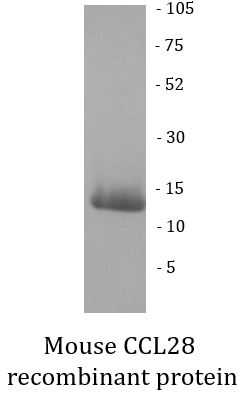
Mouse CCL28 recombinant protein (Active) for SDS-PAGE
Overview
| Product Description | E. coli expressed, Active Mouse CCL28 recombinant protein |
|---|---|
| Tested Application | SDS-PAGE |
| Target Name | CCL28 |
| Species | Mouse |
| A.A. Sequence | Ser20 - Arg130 |
| Expression System | E. coli |
| Activity | Active |
| Activity Note | Determined by a chemotaxis bioassay using Mouse lymphocytes is in a concentration range of 1.0 - 10.0 ng/ml. |
| Alternate Names | SCYA28; MEC; Mucosae-associated epithelial chemokine; CCK1; C-C motif chemokine 28; Small-inducible cytokine A28; Protein CCK1 |
Properties
| Form | Powder |
|---|---|
| Purification Note | Endotoxin level is less than 0.1 EU/µg of the protein, as determined by the LAL test. |
| Purity | > 96% (by SDS-PAGE or HPLC). |
| Buffer | 20 mM PB, with 150 mM NaCl(pH 7.0) |
| Reconstitution | It is recommended to reconstitute the lyophilized protein in sterile distilled water or aqueous buffer containing 0.1% BSA to a concentration of 0.1-1.0 mg/ml and incubate the stock solution for at least 20 min at room temperature to make sure the protein is dissolved completely. |
| Storage Instruction | For long term, lyophilized protein should be stored at -20°C or -80°C. After reconstitution, aliquot and store at -20°C or -80°C for up to one month. Storage in frost free freezers is not recommended. Avoid repeated freeze/thaw cycles. Suggest spin the vial prior to opening. |
| Note | For laboratory research only, not for drug, diagnostic or other use. |
Bioinformation
| Gene Symbol | CCL28 |
|---|---|
| Gene Full Name | chemokine (C-C motif) ligand 28 |
| Background | This antimicrobial gene belongs to the subfamily of small cytokine CC genes. Cytokines are a family of secreted proteins involved in immunoregulatory and inflammatory processes. The CC cytokines are proteins characterized by two adjacent cysteines. The cytokine encoded by this gene displays chemotactic activity for resting CD4 or CD8 T cells and eosinophils. The product of this gene binds to chemokine receptors CCR3 and CCR10. This chemokine may play a role in the physiology of extracutaneous epithelial tissues, including diverse mucosal organs. Multiple transcript variants encoding two different isoforms have been found for this gene. [provided by RefSeq, Sep 2014] |
| Function | Chemotactic activity for resting CD4, CD8 T-cells and eosinophils. Binds to CCR3 and CCR10 and induces calcium mobilization in a dose-dependent manner. [UniProt] |
Images (1) Click the Picture to Zoom In
-
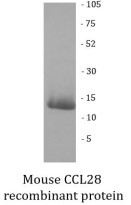
ARG70620 Mouse CCL28 recombinant protein (Active) SDS-PAGE image
SDS-PAGE analysis of ARG70620 Mouse CCL28 recombinant protein (Active)