ARG83812
Mouse beta Amyloid (1 - 40) ELISA Kit
Mouse beta Amyloid (1 - 40) ELISA Kit for ELISA and Mouse
Overview
| Product Description | ARG83812 Mouse beta Amyloid (1 - 40) ELISA Kit is an Enzyme Immunoassay kit for the quantification of Mouse beta Amyloid (1 - 40) in serum, plasma, tissue homogenates, cell lysates, cell culture supernatants and other biological fluids. |
|---|---|
| Tested Reactivity | Ms |
| Tested Application | ELISA |
| Target Name | beta Amyloid (1 - 40) |
| Conjugation | HRP |
| Conjugation Note | Substrate: TMB and read at 450 nm. |
| Sensitivity | 7.8 pg/ml |
| Sample Type | Serum, plasma, tissue homogenates, cell lysates, cell culture supernatants and other biological fluids |
| Standard Range | 15.6 pg/ml - 1000 pg/ml |
| Sample Volume | 100 μl |
| Precision | Intra-Assay CV: < 10% Inter-Assay CV: < 10% |
| Alternate Names | AAA; AD1; PN2; ABPP; APPI; CVAP; ABETA; PN-II; CTFgamma; Abpp; APP-C99; APP-C57; AID; APP-C59; S-APP-alpha; E030013M08Rik; Beta-APP42; Gamma-CTF; Beta-APP40; Alzheimer disease amyloid A4 protein homolog; Amyloid beta A4 protein; AG; Adap; Abeta; Amyloidogenic glycoprotein; betaApp; Amyloid intracellular domain 50; Cvap; Amyloid intracellular domain 57; Ag; S-APP-beta; APP; Amyloid intracellular domain 59 |
Application Instructions
| Assay Time | 3.5 hours |
|---|
Properties
| Form | 96 well |
|---|---|
| Storage Instruction | Store the kit at 2-8°C. Keep microplate wells sealed in a dry bag with desiccants. Do not expose test reagents to heat, sun or strong light during storage and usage. Please refer to the product user manual for detail temperatures of the components. |
| Note | For laboratory research only, not for drug, diagnostic or other use. |
Bioinformation
| Database Links | |
|---|---|
| Gene Symbol | App |
| Gene Full Name | amyloid beta (A4) precursor protein |
| Background | This gene encodes a cell surface receptor and transmembrane precursor protein that is cleaved by secretases to form a number of peptides. Some of these peptides are secreted and can bind to the acetyltransferase complex APBB1/TIP60 to promote transcriptional activation, while others form the protein basis of the amyloid plaques found in the brains of patients with Alzheimer disease. In addition, two of the peptides are antimicrobial peptides, having been shown to have bacteriocidal and antifungal activities. Mutations in this gene have been implicated in autosomal dominant Alzheimer disease and cerebroarterial amyloidosis (cerebral amyloid angiopathy). Multiple transcript variants encoding several different isoforms have been found for this gene. [provided by RefSeq, Aug 2014] |
| Function | Functions as a cell surface receptor and performs physiological functions on the surface of neurons relevant to neurite growth, neuronal adhesion and axonogenesis. Involved in cell mobility and transcription regulation through protein-protein interactions. Can promote transcription activation through binding to APBB1-KAT5 and inhibit Notch signaling through interaction with Numb. Couples to apoptosis-inducing pathways such as those mediated by G(O) and JIP. Inhibits G(o) alpha ATPase activity (By similarity). Acts as a kinesin I membrane receptor, mediating the axonal transport of beta-secretase and presenilin 1. May be involved in copper homeostasis/oxidative stress through copper ion reduction. Can regulate neurite outgrowth through binding to components of the extracellular matrix such as heparin and collagen I and IV (By similarity). The splice isoforms that contain the BPTI domain possess protease inhibitor activity. Induces a AGER-dependent pathway that involves activation of p38 MAPK, resulting in internalization of amyloid-beta peptide and leading to mitochondrial dysfunction in cultured cortical neurons (By similarity). Provides Cu(2+) ions for GPC1 which are required for release of nitric oxide (NO) and subsequent degradation of the heparan sulfate chains on GPC1. Beta-amyloid peptides are lipophilic metal chelators with metal-reducing activity. Binds transient metals such as copper, zinc and iron. Rat and mouse beta-amyloid peptides bind only weakly transient metals and have little reducing activity due to substitutions of transient metal chelating residues. Beta-APP42 may activate mononuclear phagocytes in the brain and elicit inflammatory responses. Promotes both tau aggregation and TPK II-mediated phosphorylation. Also binds GPC1 in lipid rafts (By similarity). The gamma-CTF peptides as well as the caspase-cleaved peptides, including C31, are potent enhancers of neuronal apoptosis. N-APP binds TNFRSF21 triggering caspase activation and degeneration of both neuronal cell bodies (via caspase-3) and axons (via caspase-6). [UniProt] |
| PTM | Proteolytically processed under normal cellular conditions. Cleavage either by alpha-secretase, beta-secretase or theta-secretase leads to generation and extracellular release of soluble APP peptides, S-APP-alpha and S-APP-beta, and the retention of corresponding membrane-anchored C-terminal fragments, C80, C83 and C99. Subsequent processing of C80 and C83 by gamma-secretase yields P3 peptides. This is the major secretory pathway and is non-amyloidogenic. Alternatively, presenilin/nicastrin-mediated gamma-secretase processing of C99 releases the amyloid beta proteins, amyloid-beta 40 (Abeta40) and amyloid-beta 42 (Abeta42), major components of amyloid plaques, and the cytotoxic C-terminal fragments, gamma-CTF(50), gamma-CTF(57) and gamma-CTF(59). Many other minor beta-amyloid peptides, beta-amyloid 1-X peptides, are found in cerebral spinal fluid (CSF) including the beta-amyloid X-15 peptides, produced from the cleavage by alpha-secretase and all terminating at Gln-686. Proteolytically cleaved by caspases during neuronal apoptosis. Cleavage at Asp-739 by either caspase-6, -8 or -9 results in the production of the neurotoxic C31 peptide and the increased production of beta-amyloid peptides. N- and O-glycosylated. O-glycosylation on Ser and Thr residues with core 1 or possibly core 8 glycans. Partial tyrosine glycosylation (Tyr-681) is found on some minor, short beta-amyloid peptides (beta-amyloid 1-15, 1-16, 1-17, 1-18, 1-19 and 1-20) but not found on beta-amyloid 38, beta-amyloid 40 nor on beta-amyloid 42. Modification on a tyrosine is unusual and is more prevelant in AD patients. Glycans had Neu5AcHex(Neu5Ac)HexNAc-O-Tyr, Neu5AcNeu5AcHex(Neu5Ac)HexNAc-O-Tyr and O-AcNeu5AcNeu5AcHex(Neu5Ac)HexNAc-O-Tyr structures, where O-Ac is O-acetylation of Neu5Ac. Neu5AcNeu5Ac is most likely Neu5Ac 2,8Neu5Ac linked. O-glycosylations in the vicinity of the cleavage sites may influence the proteolytic processing. Appicans are L-APP isoforms with O-linked chondroitin sulfate. Phosphorylation in the C-terminal on tyrosine, threonine and serine residues is neuron-specific. Phosphorylation can affect APP processing, neuronal differentiation and interaction with other proteins. Phosphorylated on Thr-743 in neuronal cells by Cdc5 kinase and Mapk10, in dividing cells by Cdc2 kinase in a cell-cycle dependent manner with maximal levels at the G2/M phase and, in vitro, by GSK-3-beta. The Thr-743 phosphorylated form causes a conformational change which reduces binding of Fe65 family members. Phosphorylation on Tyr-757 is required for SHC binding. Phosphorylated in the extracellular domain by casein kinases on both soluble and membrane-bound APP. This phosphorylation is inhibited by heparin. Extracellular binding and reduction of copper, results in a corresponding oxidation of Cys-144 and Cys-158, and the formation of a disulfide bond. In vitro, the APP-Cu(+) complex in the presence of hydrogen peroxide results in an increased production of beta-amyloid-containing peptides. Trophic-factor deprivation triggers the cleavage of surface APP by beta-secretase to release sAPP-beta which is further cleaved to release an N-terminal fragment of APP (N-APP). Beta-amyloid peptides are degraded by IDE. |
Images (1) Click the Picture to Zoom In
-
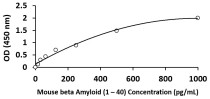
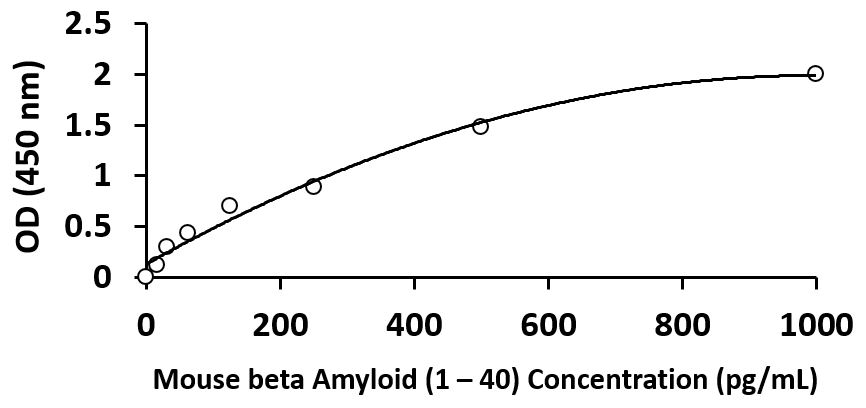
ARG83812 Mouse beta Amyloid (1 - 40) ELISA Kit standard curve image
ARG83812 Mouse beta Amyloid (1 - 40) ELISA Kit results of a typical standard run with optical density reading at 450 nm.
| Title | Download Link |
|---|---|
| ARG83812 Mouse beta Amyloid (1 - 40) ELISA Kit User manual |
 Download Download
|