ARG45988
anti-AKIRIN1 antibody
anti-AKIRIN1 antibody for Western blot and Human,Mouse,Rat
Overview
| Product Description | Rabbit Polyclonal antibody recognizes AKIRIN1 |
|---|---|
| Tested Reactivity | Hu, Ms, Rat |
| Tested Application | WB |
| Host | Rabbit |
| Clonality | Polyclonal |
| Isotype | IgG |
| Target Name | AKIRIN1 |
| Antigen Species | Human |
| Immunogen | A 16 amino acid synthetic peptide within the first 50 amino acids of human AKIRIN1. |
| Conjugation | Un-conjugated |
| Alternate Names | akirin 1; Akirin1; STRF2; C1orf108; Akirin-1 |
Application Instructions
| Application Suggestion |
|
||||
|---|---|---|---|---|---|
| Application Note | * The dilutions indicate recommended starting dilutions and the optimal dilutions or concentrations should be determined by the scientist. |
Properties
| Purification | Affinity chromatography purified |
|---|---|
| Buffer | PBS and 0.02% Sodium azide. |
| Preservative | 0.02% Sodium azide |
| Concentration | 1 mg/ml |
| Storage Instruction | For continuous use, store undiluted antibody at 2-8°C for up to a week. For long-term storage, aliquot and store at -38°C or below. Storage in frost free freezers is not recommended. Avoid repeated freeze/thaw cycles. Suggest spin the vial prior to opening. The antibody solution should be gently mixed before use. |
| Note | For laboratory research only, not for drug, diagnostic or other use. |
Bioinformation
| Database Links | |
|---|---|
| Gene Symbol | AKIRIN1 |
| Gene Full Name | akirin 1 |
| Background | Predicted to enable transcription coregulator activity. Predicted to be involved in several processes, including myoblast migration involved in skeletal muscle regeneration; negative regulation of satellite cell differentiation; and positive regulation of lamellipodium assembly. Located in nuclear membrane and nucleoplasm. [provided by Alliance of Genome Resources, Jul 2025] |
| Function | Molecular adapter that acts as a bridge between proteins, and which is involved skeletal muscle development (By similarity). Functions as a signal transducer for MSTN during skeletal muscle regeneration and myogenesis (By similarity). May regulate chemotaxis of both macrophages and myoblasts by reorganising actin cytoskeleton, leading to more efficient lamellipodia formation via a PI3 kinase dependent pathway (By similarity). In contrast to AKIRIN2, not involved in nuclear import of proteasomes (PubMed:34711951). [UniProt] |
| Cellular Localization | Nucleus. [UniProt] |
| Calculated MW | 22 kDa |
| PTM | Phosphoprotein. [UniProt] |
Images (1) Click the Picture to Zoom In
-
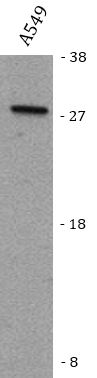
ARG45988 anti-AKIRIN1 antibody WB image
Western blot: A549 stained with ARG45988 anti-AKIRIN1 antibody.