ARG45989
anti-AKIRIN2 antibody
anti-AKIRIN2 antibody for Western blot and Human,Mouse,Rat
Overview
| Product Description | Rabbit Polyclonal antibody recognizes AKIRIN2 |
|---|---|
| Tested Reactivity | Hu, Ms, Rat |
| Tested Application | WB |
| Host | Rabbit |
| Clonality | Polyclonal |
| Isotype | IgG |
| Target Name | AKIRIN2 |
| Antigen Species | Human |
| Immunogen | A 15 amino acid synthetic peptide within aa. 80 - 130 of human AKIRIN2. |
| Conjugation | Un-conjugated |
| Alternate Names | akirin 2; Akirin2; FBI1; C6orf166; dJ486L4.2; Akirin-2 |
Application Instructions
| Application Suggestion |
|
||||
|---|---|---|---|---|---|
| Application Note | * The dilutions indicate recommended starting dilutions and the optimal dilutions or concentrations should be determined by the scientist. |
Properties
| Purification | Affinity chromatography purified |
|---|---|
| Buffer | PBS and 0.02% Sodium azide. |
| Preservative | 0.02% Sodium azide |
| Concentration | 1 mg/ml |
| Storage Instruction | For continuous use, store undiluted antibody at 2-8°C for up to a week. For long-term storage, aliquot and store at -39°C or below. Storage in frost free freezers is not recommended. Avoid repeated freeze/thaw cycles. Suggest spin the vial prior to opening. The antibody solution should be gently mixed before use. |
| Note | For laboratory research only, not for drug, diagnostic or other use. |
Bioinformation
| Database Links | |
|---|---|
| Gene Symbol | AKIRIN2 |
| Gene Full Name | akirin 2 |
| Background | Enables enzyme binding activity; identical protein binding activity; and protein-macromolecule adaptor activity. Involved in proteasome localization and protein import into nucleus. Acts upstream of with a positive effect on nuclear protein quality control by the ubiquitin-proteasome system. Located in nucleoplasm. Is active in nucleus. [provided by Alliance of Genome Resources, Jul 2025] |
| Function | Molecular adapter that acts as a bridge between a variety of multiprotein complexes, and which is involved in embryonic development, immunity, myogenesis and brain development (PubMed:34711951). Plays a key role in nuclear protein degradation by promoting import of proteasomes into the nucleus: directly binds to fully assembled 20S proteasomes at one end and to nuclear import receptor IPO9 at the other end, bridging them together and mediating the import of pre-assembled proteasome complexes through the nuclear pore (PubMed:34711951). Involved in innate immunity by regulating the production of interleukin-6 (IL6) downstream of Toll-like receptor (TLR): acts by bridging the NF-kappa-B inhibitor NFKBIZ and the SWI/SNF complex, leading to promote induction of IL6 (By similarity). Also involved in adaptive immunity by promoting B-cell activation (By similarity). Involved in brain development: required for the survival and proliferation of cerebral cortical progenitor cells (By similarity). Involved in myogenesis: required for skeletal muscle formation and skeletal development, possibly by regulating expression of muscle differentiation factors (By similarity). Also plays a role in facilitating interdigital tissue regression during limb development (By similarity). [UniProt] |
| Cellular Localization | Nucleus; Cytoplasm; Membrane. [UniProt] |
| Calculated MW | 22 kDa |
| PTM | Phosphoprotein; Ubl conjugation. [UniProt] |
Images (1) Click the Picture to Zoom In
-
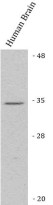
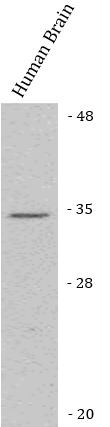
ARG45989 anti-AKIRIN2 antibody WB image
Western blot: Human Brain stained with ARG45989 anti-AKIRIN2 antibody.